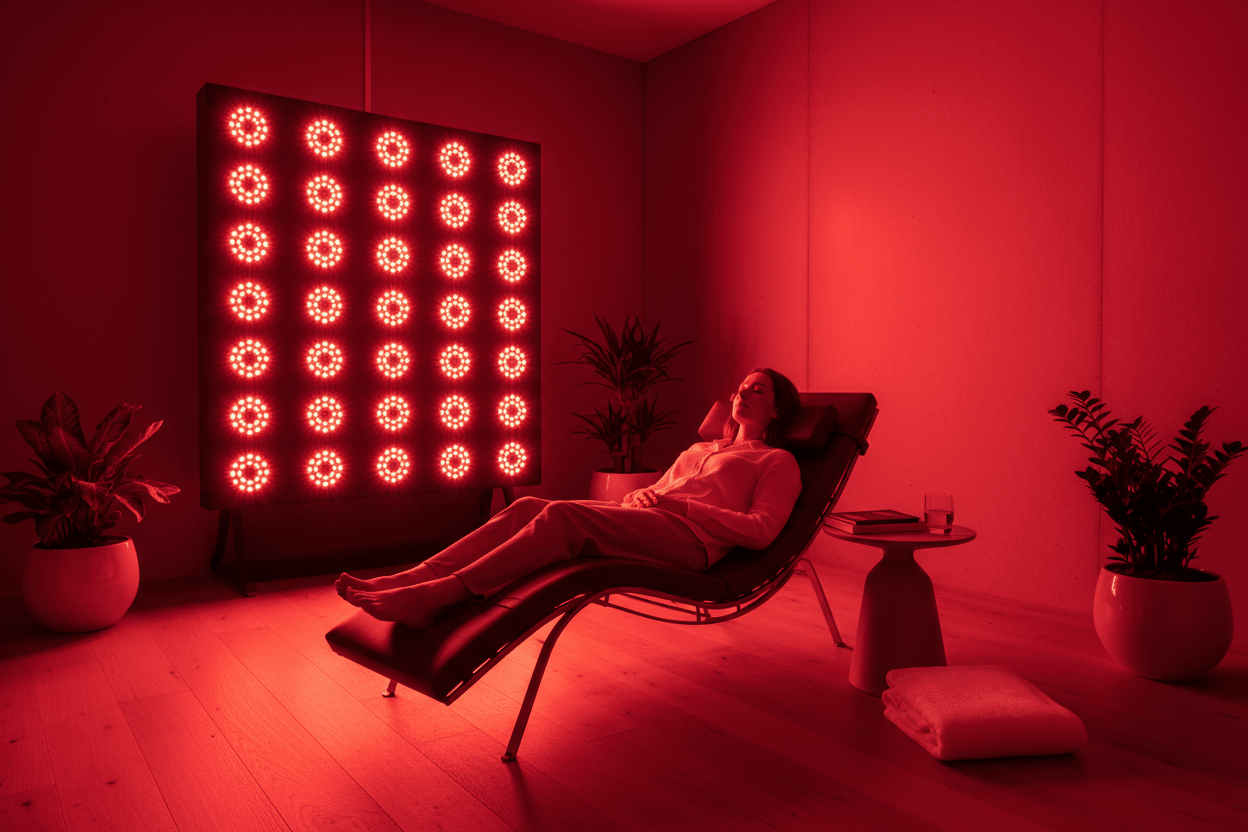
Zone 2 Cardio, Red Light Therapy & Infrared Sauna for Better Mitochondrial Health
Cellular Energy & Recovery Guide
Mitochondria help cells convert nutrients into usable energy, coordinate stress responses, and adapt to physical demand. Exercise is the most established lifestyle stimulus for improving mitochondrial capacity. Red and near-infrared photobiomodulation and sauna are being studied as supportive recovery tools, but they are not interchangeable—and neither replaces training, sleep, nutrition, or medical care.
Reviewed and updated: July 17, 2026 | Reading time: Approximately 18 minutes
Quick Answer
Zone 2-style aerobic training can improve oxidative capacity, fat oxidation, and mitochondrial adaptations, but there is no universal heart-rate zone that works for everyone.
Higher-intensity intervals and resistance training also support mitochondrial health. Zone 2 should be part of a balanced program—not presented as the only effective intensity.
Red and near-infrared photobiomodulation may modulate mitochondrial signaling and ATP production under specific doses. More light is not always better, and device parameters matter.
Infrared sauna primarily provides passive heat. It may support relaxation and heat acclimation, but a sauna cabin does not deliver the same optical dose as a red-light therapy panel.
Mitochondria: More Than Cellular “Power Plants”
Mitochondria help generate adenosine triphosphate, or ATP, through oxidative phosphorylation. They also participate in calcium handling, redox signaling, heat production, programmed cell death, and adaptation to exercise.
The number and function of mitochondria vary by tissue. Skeletal muscle, heart, brain, and other energy-demanding tissues contain many mitochondria, while mature red blood cells contain none. Statements that one organelle determines how “biologically young” a person feels oversimplify aging and energy.
Factors That Influence Mitochondrial Function
- Physical activity and training history
- Age and genetics
- Sleep and circadian timing
- Nutrition and energy availability
- Cardiometabolic health
- Medication and disease
- Smoking, alcohol, and environmental exposures
- Periods of inactivity, injury, or bed rest
Fatigue Is Not a Mitochondrial Diagnosis
Persistent fatigue can relate to sleep disorders, anemia, thyroid disease, infection, medication, depression, cardiovascular disease, overtraining, under-fueling, or other causes. A wellness routine should not replace evaluation for ongoing symptoms.
Mitochondrial Biogenesis and the Role of PGC-1α
Mitochondrial biogenesis is the coordinated process through which cells expand or remodel mitochondrial content and function. Exercise can activate signaling pathways involving AMP-activated protein kinase, calcium-dependent signaling, p38 MAPK, sirtuins, and peroxisome proliferator-activated receptor gamma coactivator 1-alpha, commonly abbreviated PGC-1α.
PGC-1α is an important regulator, but it is not a literal on/off master switch. Adaptation involves transcription, protein turnover, mitochondrial dynamics, mitophagy, vascular changes, substrate transport, and repeated recovery between training sessions.
| Adaptation | What It Means | How It Is Commonly Stimulated |
|---|---|---|
| Biogenesis | Expansion and remodeling of mitochondrial machinery | Repeated endurance and interval training |
| Oxidative capacity | Greater ability to use oxygen and produce energy aerobically | Aerobic training across appropriate intensities |
| Mitophagy | Removal and recycling of damaged mitochondrial components | Exercise, energy signaling, recovery |
| Fusion and fission | Dynamic reshaping of the mitochondrial network | Training, cellular stress, recovery |
| Capillarization | Improved delivery of oxygen and nutrients to muscle | Consistent endurance exercise |
Zone 2 Cardio: A Sustainable Aerobic Foundation
“Zone 2” is used differently across five-zone, six-zone, laboratory, and consumer wearable systems. In practical conversation, it often means a steady, moderate effort below the first lactate or ventilatory threshold.
Many people can maintain this intensity while speaking in sentences, although a talk test is only an estimate. Fixed percentages of maximum heart rate may be inaccurate for people taking beta blockers, people with unusually high or low heart rates, and those with medical conditions.
Why Moderate Aerobic Work Helps
- Supports repeated training volume with manageable fatigue
- Improves aerobic enzymes and oxidative capacity
- Supports fat oxidation at submaximal workloads
- Improves cardiovascular efficiency
- Can be scaled through walking, cycling, rowing, swimming, or elliptical training
Zone 2 Is Not Automatically “Maximum Fat Burning”
The intensity of maximal fat oxidation varies by fitness, diet, training status, and measurement method. Burning a larger percentage of fat during one workout does not automatically produce more body-fat loss or superior longevity.
Beginner Zone 2 Framework
- Begin with 20–30 minutes at a sustainable conversational effort.
- Use a modality that does not aggravate joints or injury.
- Increase weekly duration gradually.
- Include a warm-up and cool-down.
- Do not chase a wearable zone if symptoms or effort disagree.
- Seek medical guidance before starting when cardiovascular risk or symptoms are present.
HIIT and Resistance Training Also Support Mitochondrial Health
The original draft suggested that high-intensity exercise can suppress mitochondrial growth when it dominates training. Excessive training without recovery can impair performance, but appropriately programmed intervals are a potent mitochondrial stimulus.
Research reviews show that training volume, intensity, and duration can all influence PGC-1α-related signaling and mitochondrial adaptation. Studies in older adults also show that resistance training can increase mitochondrial respiratory-chain protein content and support muscle health.
| Training Type | Main Value | Common Limitation |
|---|---|---|
| Moderate continuous aerobic work | Sustainable volume and aerobic base | Can become repetitive or insufficient alone for all fitness goals |
| High-intensity intervals | Strong cardiorespiratory and mitochondrial stimulus in less time | Higher fatigue and greater need for screening and recovery |
| Resistance training | Strength, muscle, bone, function, and mitochondrial protein adaptations | Requires technique and progressive loading |
| Daily low-intensity movement | Supports energy expenditure and reduces sedentary time | Does not replace structured fitness training |
The best program is usually mixed: moderate aerobic sessions, appropriate higher-intensity work, resistance training, and regular movement.
Red and Near-Infrared Photobiomodulation: A Dose-Dependent Adjunct
Photobiomodulation uses red and near-infrared light at nonthermal or low-thermal doses. Proposed mechanisms involve cytochrome c oxidase, nitric oxide, calcium signaling, reactive oxygen species, and other photoreceptors or ion channels.
A 2024 review describes modulation of ATP, reactive oxygen species, and intracellular calcium after light absorption, with downstream effects that depend on fluence, power, duration, wavelength, tissue, and condition.
What the Evidence Supports
- Biologically plausible effects on mitochondrial and cell signaling
- Clinical evidence in selected dermatologic, pain, wound, and recovery applications
- Possible exercise-performance or recovery effects under specific protocols
- A generally favorable safety profile when devices are used correctly
What the Evidence Does Not Support
- A universal doubling or 200% increase in ATP in humans
- Guaranteed whole-body mitochondrial biogenesis
- One wavelength or pulsing frequency for every goal
- The assumption that more intensity or longer exposure is better
- Replacement of exercise with passive light exposure
Photobiomodulation Has a Biphasic Dose Response
Too little may do nothing, while excessive dose may reduce benefit or increase irritation. Follow the device’s distance, time, frequency, and eye-safety instructions.
Compare device formats in Wellari’s Red Light Panels vs. Beds vs. Wearables, Red Light Panel vs. Belt vs. Mask, and Red Light vs. Infrared Therapy.
Infrared Sauna Is Not the Same as Red Light Therapy
Infrared sauna cabins are primarily heat systems. They warm the user through infrared-emitting heaters and the cabin environment. Red-light panels are designed to deliver specific optical wavelengths and doses to exposed tissue.
A full-spectrum sauna may include near-, mid-, and far-infrared heaters, but the term “full spectrum” does not mean it delivers a measured photobiomodulation dose equivalent to a clinical LED or laser system.
| Feature | Red/NIR Light Panel | Infrared Sauna |
|---|---|---|
| Primary purpose | Photobiomodulation | Passive heating and relaxation |
| Typical output description | Wavelength, irradiance, fluence, distance | Heater spectrum, cabin temperature, heater coverage |
| Typical session experience | Localized or whole-body light exposure with limited heating | Progressive whole-body heat and sweating |
| Main physiologic stress | Light dose | Thermal and cardiovascular load |
| Evidence transfer | Panel evidence does not validate every sauna | Sauna evidence does not validate every light panel |
Wellari’s Infrared & Full-Spectrum Sauna Buyer’s Guide explains heater types, room requirements, electrical planning, and product comparisons.
Should Red Light or Sauna Come Before or After Zone 2?
There is no universal sequence proven to maximize mitochondrial biogenesis. Timing depends on the desired outcome, device, tolerance, and training plan.
Red Light Before Training
Some exercise studies have used photobiomodulation before activity with the goal of supporting performance or reducing fatigue. Results vary and depend on dose and muscle coverage.
Red Light After Training
Post-exercise use is common in recovery routines. It may be convenient and has been studied for soreness and recovery outcomes, but it should not be described as amplifying every exercise adaptation.
Sauna After Training
Heat after exercise can extend thermal and cardiovascular stress. Some trained users enjoy it, but dehydration, dizziness, active insulin, illness, and high training load can increase risk.
Sauna Before Training
Pre-exercise heat may impair performance or contribute to dehydration. It is generally not the simplest starting point for a beginner.
Sequence for Safety and Adherence First
A sustainable routine that preserves training quality, hydration, and sleep is more valuable than an unproven “perfect” order.
A Practical Weekly Mitochondrial Health Framework
This is a general educational example, not a medical or athletic prescription.
| Day | Primary Activity | Optional Wellness Tool |
|---|---|---|
| Monday | 30–45 minutes moderate aerobic work | Brief red/NIR session per device instructions |
| Tuesday | Full-body resistance training | Mobility or massage recovery |
| Wednesday | Walking or easy recovery activity | Short infrared sauna if well tolerated |
| Thursday | Moderate aerobic session or intervals based on fitness | No device required |
| Friday | Resistance training | Targeted red-light session if desired |
| Weekend | Longer easy aerobic session, recreation, or rest | Optional sauna or complete rest |
Progression Principles
- Increase training volume gradually.
- Keep at least one easy or rest day.
- Do not add heat and hard intervals simultaneously when unaccustomed.
- Use adequate food, fluids, and sleep to support adaptation.
- Reduce load when performance, mood, sleep, or resting heart rate worsens persistently.
For a broader equipment sequence, read The Ultimate Home Wellness Stack and The Ultimate Longevity Stack Explained.
Can Older Adults Improve Mitochondrial Function?
Aging is associated with changes in muscle mass, physical activity, mitochondrial function, and recovery, but adaptation remains possible. Reviews describe exercise as a key intervention for mitochondrial and muscle health in older adults.
Resistance training is especially important because muscle strength and function affect independence, fall risk, glucose handling, and quality of life. Aerobic fitness and strength should not be treated as competing longevity goals.
Start With Function, Not “Biological Age” Claims
- Walking speed and endurance
- Ability to climb stairs
- Strength for daily tasks
- Balance and fall prevention
- Blood pressure and cardiometabolic health
- Consistency over months and years
New Exercise Intolerance Needs Evaluation
Chest discomfort, fainting, unexplained shortness of breath, sudden performance decline, persistent palpitations, or severe fatigue should not be self-treated as “mitochondrial decline.”
How to Track Mitochondrial Fitness Without Overpromising
No consumer wearable directly measures mitochondrial density or PGC-1α activity. Useful progress indicators are functional and longitudinal.
Practical Metrics
- Pace or power at the same comfortable heart rate
- Heart rate at the same workload
- Duration tolerated at conversational effort
- Recovery between sessions
- Strength progression
- Resting heart rate trends
- Sleep, energy, and symptoms
Laboratory Options
VO2 testing, ventilatory thresholds, lactate testing, and metabolic-cart assessment can provide more precise exercise zones. These tests still do not directly measure every aspect of mitochondrial health.
HRV reflects autonomic variation, not mitochondrial function. It can offer recovery context but should not be treated as proof of cellular regeneration.
Safety and Contraindications
Exercise Screening
Seek medical guidance before starting or intensifying exercise if you have known cardiovascular, pulmonary, metabolic, neurologic, or orthopedic disease; concerning symptoms; pregnancy; or a long period of inactivity with risk factors.
Red Light Precautions
- Follow the exact device distance and time.
- Use eye protection when required.
- Ask about photosensitizing medications and conditions.
- Do not use over suspicious skin lesions instead of seeking evaluation.
- Avoid combining multiple high-dose devices without guidance.
Sauna Precautions
- Avoid use when dehydrated, feverish, intoxicated, or acutely ill.
- Use caution with blood-pressure medication or fainting history.
- Ask a clinician about pregnancy, heart disease, kidney disease, or impaired sweating.
- Stop for chest pain, severe dizziness, confusion, or unusual shortness of breath.
- Do not sleep in a sauna or heated enclosure.
How to Choose Red Light and Infrared Equipment
Red Light Panel Checklist
- Published wavelengths
- Irradiance at a stated distance
- Treatment area and beam angle
- Independent red/NIR controls
- Timer and brightness control
- Mounting or stand options
- Eye-safety instructions
- Warranty and technical support
Infrared Sauna Checklist
- Far-infrared vs. full-spectrum heaters
- Cabin size and user capacity
- Electrical requirements
- Temperature control
- Ventilation and room placement
- Wood and cleaning requirements
- Delivery and assembly
- Warranty and replacement parts
Exercise Equipment Checklist
- Modality you will use consistently
- Stable hand supports when needed
- Heart-rate or power display appropriate to the goal
- Low starting resistance
- Space, ceiling height, floor load, and power
- Service and warranty availability
Wellari Products for a Mitochondrial-Focused Wellness Space
These general-wellness products do not diagnose or treat mitochondrial disease. They may support a broader routine built around exercise, relaxation, and consistent recovery habits.
SN1500 Full-Body Red Light Panel
A large red and near-infrared LED panel for broad exposure and straightforward home routines.
SNPRO1500 Smart Red Light Panel
Adds touchscreen controls, adjustable brightness, timing, and programmable operation.
SN3000 Large-Format Red Light Panel
A higher-coverage option for dedicated home or professional wellness spaces.
Avila Elite 1-Person Infrared Sauna
A compact far-infrared cabin for individual heat-based relaxation routines.
Cardoba 2-Person Full-Spectrum Sauna
A two-person cabin combining near-, mid-, and far-infrared heating elements.
Santiago 2-Person Infrared Sauna
A space-conscious two-person option for a shared home recovery area.
VibePlate Rev
A compact vibration platform for movement preparation and general recovery routines.
PreCon3 Vibration Platform
A commercial-style system designed for warm-up and mobility preparation.
Browse Wellari’s red light therapy systems, red light panels, infrared saunas, full-spectrum saunas, and vibration platforms.
Illustrative Case: Building a Sustainable Cellular-Fitness Routine
Case type: Educational planning example—not a medical outcome or customer testimonial.
A sedentary adult in their early 50s wants more energy and plans to perform five 60-minute Zone 2 sessions, daily red light, and a 30-minute sauna after every workout.
Poor Approach
- Adds a large exercise volume immediately
- Uses a wearable heart-rate formula as an exact threshold
- Treats sauna dehydration as evidence of detoxification
- Uses maximum red-light dose because more seems better
- Skips resistance training
Stronger Approach
- Obtains appropriate exercise clearance.
- Starts with three 25-minute moderate sessions.
- Adds two basic resistance sessions.
- Introduces red light separately according to device instructions.
- Uses sauna once weekly at a conservative dose.
- Tracks function, consistency, sleep, and symptoms for eight weeks.
Common Mitochondrial Health Myths
- “Zone 2 is the single best mitochondrial workout.” Moderate aerobic work is valuable, but intervals and resistance training also contribute.
- “PGC-1α is a simple master switch.” It is one important regulator within a complex network.
- “Zone 2 always maximizes fat burning.” The maximal fat-oxidation intensity differs among people.
- “HIIT suppresses mitochondrial growth.” Properly programmed HIIT can be a strong mitochondrial stimulus.
- “Red light increases ATP by 200%.” No universal human outcome supports this number.
- “Full-spectrum infrared directly targets mitochondrial enzymes.” Sauna is primarily a heat modality.
- “Far infrared penetrates to mitochondria and builds more of them.” This is not established as a consumer-sauna outcome.
- “Post-workout infrared amplifies biogenesis.” An optimal combined protocol has not been established.
- “Higher HRV proves better mitochondria.” HRV is an autonomic metric.
- “Mitochondrial decline cannot be improved after middle age.” Older adults retain meaningful exercise adaptability.
Frequently Asked Questions
What is mitochondrial biogenesis?
It is the coordinated expansion and remodeling of mitochondrial machinery within cells.
Is PGC-1α the master regulator of mitochondria?
It is an important regulator of mitochondrial adaptation, but it works within a larger signaling network.
What is Zone 2 cardio?
It usually refers to sustainable aerobic work below the first ventilatory or lactate threshold, though zone systems differ.
How do I know I am in Zone 2?
A conversational talk test can provide a rough estimate. Laboratory threshold testing is more precise.
Is Zone 2 the best exercise for mitochondria?
It is valuable for aerobic volume, but intervals and resistance training also support mitochondrial and metabolic health.
How long should a Zone 2 workout be?
Beginners may start with 20–30 minutes and progress gradually based on fitness, health, and recovery.
How many Zone 2 sessions should I do?
Frequency depends on the complete exercise program. Three moderate sessions can be a practical starting point for many healthy adults.
Does Zone 2 burn more body fat?
It can use a higher proportion of fat during exercise, but body-fat loss depends on overall energy balance and many other factors.
Does HIIT build mitochondria?
Yes. Appropriate high-intensity interval training can stimulate mitochondrial adaptations.
Does resistance training help mitochondria?
Yes. It supports muscle health and can increase mitochondrial protein content and related adaptations.
How does red light affect mitochondria?
Red and near-infrared light may modulate cytochrome c oxidase, nitric oxide, calcium, ATP, and cell signaling under specific doses.
Can red light double ATP production?
No universal human result supports a guaranteed doubling of ATP.
Is near-infrared better than red light for mitochondria?
They have different penetration and absorption characteristics. The best choice depends on the target and device protocol.
Is infrared sauna photobiomodulation?
No. Sauna is primarily a passive heat modality, while photobiomodulation uses measured red or near-infrared light doses.
Does sauna build mitochondria?
Heat can trigger cellular stress responses, but consumer sauna use has not been established as a substitute for exercise-driven mitochondrial adaptation.
Should I use red light before or after exercise?
Both have been studied. No single sequence is best for every goal or device.
Should I sauna after Zone 2?
Some healthy users tolerate it, but heat adds cardiovascular and hydration demands. Start conservatively.
Can older adults build new mitochondria?
Older adults retain meaningful exercise adaptability, though response and recovery vary.
Can a wearable measure mitochondrial health?
No. Wearables can track performance and recovery-related trends but do not directly measure mitochondrial density.
Does HRV measure mitochondrial function?
No. HRV primarily reflects variation in autonomic control of heart rhythm.
What is the safest first step for mitochondrial health?
Build regular movement, appropriate aerobic and resistance exercise, sleep, nutrition, and medical care before adding passive technologies.
Research and Further Reading
- Exercise Volume, Intensity, Duration, and Mitochondrial Biogenesis
- ROS, PGC-1α, AMPK, and Exercise Signaling
- Resistance Training and Skeletal-Muscle Mitochondrial Adaptation in Older Adults
- Exercise, Mitochondrial Dysfunction, and Sarcopenia in Older Adults
- Photobiomodulation Overview and Mechanisms
- Proposed Mechanisms of Photobiomodulation
- Photobiomodulation and Mitochondrial Redox Signaling
- Clinical Applications of Low-Level Light Therapy
Build a More Complete Recovery Environment
Wellari Wellness helps home users and professional facilities compare red light systems, infrared saunas, vibration platforms, room requirements, and long-term support—without replacing exercise or medical guidance.
Explore Red Light Therapy Explore Infrared SaunasWellari Wellness Editorial and Medical Disclaimer
Wellari Wellness provides general-wellness equipment and educational information. Products discussed here are not intended to diagnose, treat, cure, or prevent mitochondrial disease, fatigue disorders, metabolic disease, cardiovascular disease, or aging.
This article is not medical advice or an individualized exercise prescription. Consult qualified medical and exercise professionals before beginning a new training, heat, or light-based routine if you have symptoms, a medical condition, pregnancy, medication-related risks, photosensitivity, or uncertainty about suitability.