
How to Build the Ultimate Sleep Sanctuary for Better Recovery and Deeper Sleep
Sleep Environment & Recovery Guide
A restorative bedroom is not defined by expensive bedding or perfect décor. It is a space that supports a consistent sleep schedule, comfortable temperature, darkness, quiet, healthy indoor air, and fewer disruptions. This guide separates evidence-based sleep-environment upgrades from exaggerated claims and shows how to prioritize the changes most likely to improve comfort and consistency.
Reviewed and updated: July 17, 2026 | Reading time: Approximately 18 minutes
Quick Answer
Start with the fundamentals: a consistent sleep schedule, a dark room, a comfortably cool temperature, reduced noise, clean and adequately ventilated air, and fewer stimulating activities in bed.
There is no single perfect bedroom temperature for everyone. Around 60–67°F is commonly suggested for adults, but comfort depends on bedding, humidity, age, health, season, and personal preference.
Evening light matters more than bulb marketing. Dimming total light and reducing bright, blue-enriched light before bed is more important than purchasing a particular “circadian” product.
Routine household wireless exposure has not been proven to disrupt sleep. Moving phones and routers away from the bed can still reduce notifications, screen use, heat, clutter, and nighttime interruptions.
The Biological Case for Better Sleep Infrastructure
Sleep is regulated by two major interacting processes: sleep pressure that builds during wakefulness and the circadian system that helps time alertness and sleep across the day. Light and darkness are major circadian cues, while activity, meals, temperature, stress, and social timing can also influence daily rhythms.
The bedroom cannot compensate for untreated sleep apnea, restless legs syndrome, insomnia, medication effects, pain, or severe menopause symptoms. But a poor environment can make an existing sleep problem harder to manage.
| Environmental Factor | Why It Matters | Practical Goal |
|---|---|---|
| Temperature | Thermal discomfort can cause awakenings and make sleep onset harder | Comfortably cool, not painfully cold |
| Light | Evening and nighttime light can affect circadian timing and melatonin | Bright days, dim evenings, dark sleep period |
| Noise | Intermittent sound can fragment sleep even without full awakening | Reduce peaks and unpredictability |
| Air | Pollutants, poor ventilation, allergens, and humidity affect comfort and respiratory health | Source control, ventilation, filtration when needed |
| Technology | Notifications, screens, heat, and engagement delay bedtime | Reduce disruption rather than chase fear-based claims |
Engineering a Comfortable Thermal Environment
The body’s temperature rhythms interact with sleep, but there is no universal requirement that every adult maintain exactly 65°F. A room that is too warm may feel restless; a room that is too cold may create muscle tension, discomfort, or repeated awakenings.
Start With Low-Cost Adjustments
- Use breathable sheets and a lighter comforter.
- Layer blankets so warmth can be adjusted during the night.
- Use a fan for airflow and sound when appropriate.
- Block direct sun during hot afternoons.
- Check humidity because humid air can feel warmer.
- Choose sleepwear matched to the season.
Active Bed Cooling and Heating
Water- or air-based mattress systems can help sleepers who overheat, share a bed with someone who prefers a different temperature, or experience night sweats. Evidence is promising but product-specific. Claims that active cooling reliably increases deep sleep by a fixed percentage should be avoided unless tied to a directly matching trial and device.
Water-Based Systems
Can provide precise surface-temperature control and dual zones, but require a control unit, tubing, maintenance, and leak planning.
Air-Based Systems
Use airflow across or within bedding. They may be easier to maintain but can create noise or drafts.
Night Sweats Deserve Context
Persistent or drenching night sweats can relate to menopause, medication, infection, endocrine conditions, sleep disorders, or other health concerns. Environmental cooling may improve comfort but does not identify the cause.
For a broader room-planning approach, read Wellari’s Home Wellness Room Layout Guide. If evening heat-based relaxation is part of the plan, compare compact options such as the Avila Elite 1-Person Infrared Sauna, the Santiago 2-Person Infrared Sauna, or Wellari’s full infrared sauna collection.
Circadian Lighting: Bright Days, Dim Evenings, Dark Nights
Light is one of the strongest environmental cues for the circadian system. Daytime light supports alertness and helps anchor timing, while bright evening light can delay sleepiness in susceptible people.
Blue-enriched light is especially effective at influencing circadian signaling, but total brightness, duration, timing, distance, and the full spectrum all matter. The practical goal is not to fear one wavelength; it is to create a strong contrast between daytime and nighttime.
Morning and Daytime
- Seek outdoor daylight soon after waking when practical.
- Open shades and use brighter work lighting during the day.
- Avoid spending the entire morning in dim indoor light.
Evening
- Dim overhead lighting one to two hours before bed.
- Use lower-level lamps rather than bright ceiling fixtures.
- Choose warm-appearing bulbs when they improve comfort.
- Lower screen brightness and stop stimulating content when possible.
- Keep hallway and bathroom lighting low but safe.
During Sleep
- Use blackout shades or a comfortable eye mask when needed.
- Cover unnecessary indicator lights.
- Use the dimmest safe night light for fall prevention.
- Avoid bright phone checks during awakenings.
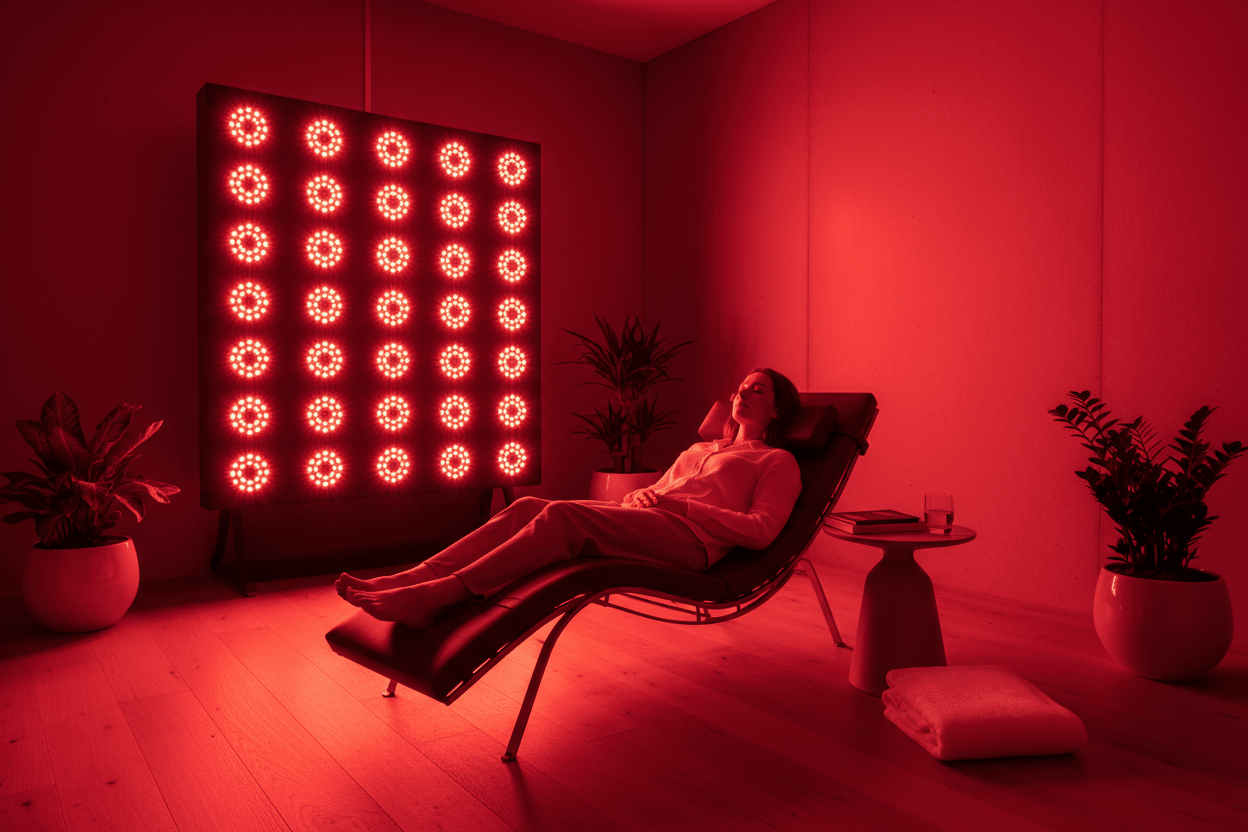
Red light therapy devices are not substitutes for circadian lighting. For device-specific guidance, see How to Use Red Light Therapy for Daily Recovery and Red Light Panels vs. Beds vs. Wearables. Buyers considering a separate daytime or early-evening recovery station can compare the SN1500 Full-Body Red Light Panel, the more programmable SNPRO1500 Smart Red Light Panel, and Wellari’s broader red light therapy collection.
Noise Control: Reduce Peaks, Not Just Average Volume
Intermittent traffic, doors, pets, televisions, and household activity can fragment sleep. The most disruptive sounds are often sudden and unpredictable rather than steady.
Practical Noise Strategies
- Move the bed away from shared or street-facing walls when possible.
- Seal obvious gaps around windows and doors.
- Use rugs, curtains, and upholstered surfaces to reduce echo.
- Choose a quiet fan or white-noise device with a timer.
- Use comfortable earplugs when safe.
- Silence nonessential alerts.
Do Not Block Safety Signals
Noise masking should not prevent a person from hearing smoke alarms, carbon-monoxide alarms, a child, a caregiver alert, or another required safety signal.
Bedroom Air Quality, Ventilation, Filtration, and Humidity
The EPA recommends three broad strategies for indoor air quality: source control, ventilation, and air cleaning. A purifier can help with particles, but it cannot solve every pollutant or ventilation problem.
Source Control Comes First
- Keep smoking and combustion pollutants out of the bedroom.
- Address moisture, mold, leaks, and pests.
- Wash bedding regularly when allergens are a concern.
- Avoid storing strong cleaners, paints, or fragrances in the room.
- Consider low-emission materials during renovation.
Ventilation
Outdoor air can dilute indoor contaminants when outdoor conditions are safe. Mechanical ventilation may be appropriate in tighter homes. Opening windows is not always advisable during wildfire smoke, extreme pollen, poor outdoor air quality, or unsafe weather.
Air Cleaners
A portable HEPA air cleaner can reduce airborne particles when correctly sized and operated. Look at room-size ratings, clean air delivery rate, noise at the speed you will actually use, replacement-filter cost, and ozone-free operation.
Humidity
Very dry air can irritate the nose and throat, while high humidity can support mold and dust mites. Humidifiers require frequent cleaning and should not be used to create persistently damp conditions.
Air Quality Checklist
- Install and maintain smoke and carbon-monoxide alarms.
- Test the home for radon where recommended.
- Replace HVAC filters according to system requirements.
- Control moisture at the source.
- Choose an appropriately sized purifier if needed.
- Avoid ozone-generating “air cleaning” devices.
Wireless Devices and EMF: What the Evidence Supports
The original draft claimed that household wireless signals keep the nervous system from disengaging during sleep. That conclusion is not supported by current public-health guidance.
The World Health Organization states that adverse health effects from low-level, long-term radiofrequency or power-frequency exposure have not been confirmed. WHO also reports no consistent evidence of altered sleep from typical base-station or wireless-network exposure.
Why a Lower-Tech Bedroom Can Still Help
- Phones encourage late-night scrolling.
- Notifications and vibration can cause awakenings.
- Charging devices create light, heat, and clutter.
- Smart displays can introduce bright screens and alerts.
- Work devices weaken the mental boundary between work and sleep.
Reasonable Steps
- Use Do Not Disturb or airplane mode when appropriate.
- Charge the phone away from the bed.
- Turn off unnecessary indicator lights.
- Remove devices that repeatedly interrupt sleep.
- Hardwire equipment when it improves reliability or reduces clutter.
Avoid Fear-Based Electrical Modifications
Do not install circuit “kill switches,” shielding fabrics, canopies, or electrical modifications as medical treatments without qualified electrical and safety advice. Poorly designed shielding can be ineffective, expensive, or create unintended hazards.
Smart Mattresses, Sleep Trackers, and Bedroom Automation
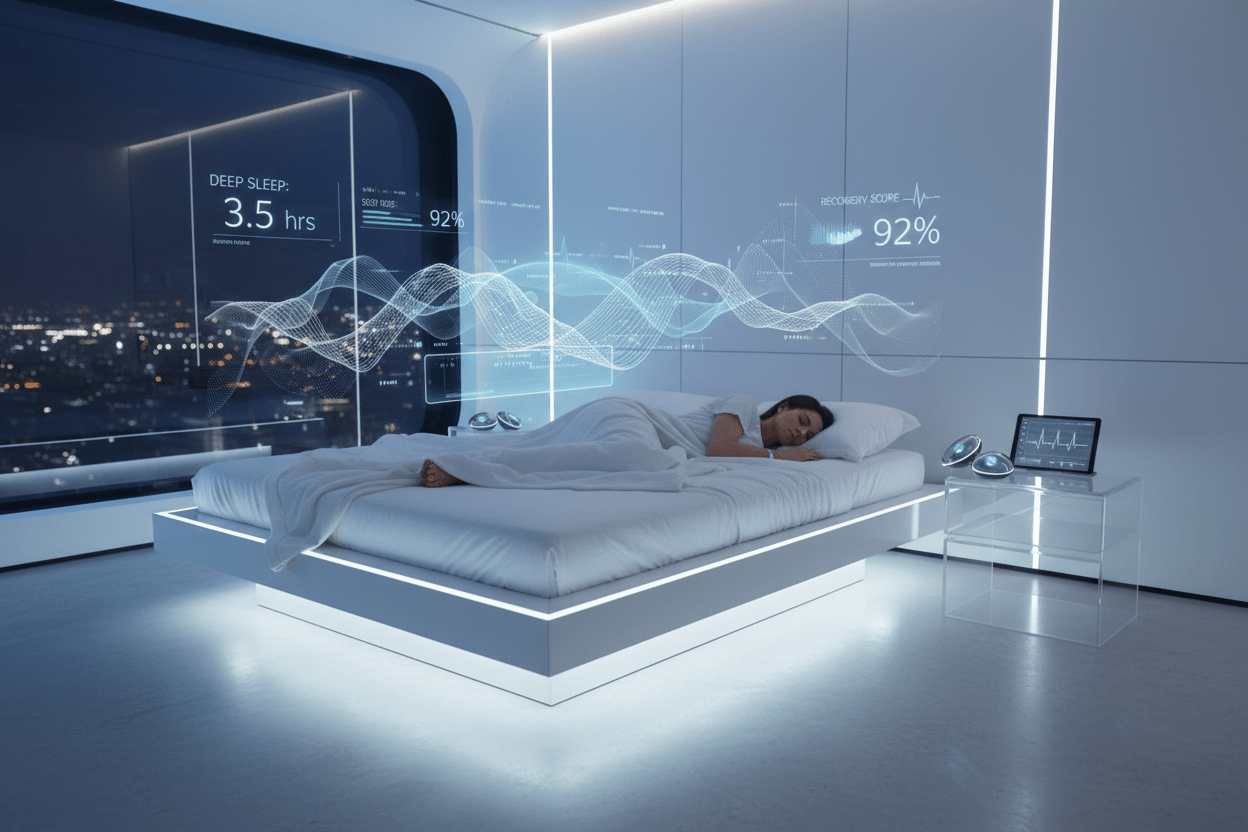
Technology can help when it removes friction. It can hurt when it creates more alerts, anxiety, maintenance, and data to manage.
| Technology | Potential Value | Limitation |
|---|---|---|
| Active bed cooling | Improves thermal comfort and partner temperature differences | Cost, noise, maintenance, device-specific evidence |
| Sunrise alarm | Gradual morning light and consistent wake cue | Not strong enough to treat every circadian disorder |
| Smart bulbs | Automated evening dimming | Brightness and timing still need to be programmed well |
| Wearable tracker | Long-term schedule and trend awareness | Sleep stages are estimates, not polysomnography |
| Contactless bed sensor | Reduced need to wear a device | Can misread movement, partners, and pets |
| Air-quality monitor | May identify CO2, particles, or humidity patterns | Consumer sensors vary in accuracy |
The One-Device Rule
Add one technology, define the problem it is meant to solve, and evaluate whether sleep actually improves over several weeks. Do not build a room around multiple devices before learning which variable matters.
Bedroom Layout and Behavioral Cues
The bedroom should make the desired behavior easy. A beautiful room can still undermine sleep if it functions as an office, gym, entertainment center, and storage space. Larger recovery products usually belong in a dedicated wellness area rather than beside the bed. For example, a VACUACTIVUS De-stress Lounge Massage Chair or Breakthrough 8 Massage Chair can support a pre-bed relaxation routine while remaining outside the primary sleep zone.
Layout Priorities
- Keep the walking path clear.
- Place controls within safe reach without creating screen temptation.
- Move work materials out of sight.
- Use closed storage to reduce visual clutter.
- Position the bed away from noisy mechanical equipment when possible.
- Keep cords, heaters, humidifiers, and cooling systems safely arranged.
For larger recovery-space projects, review Design Your Dream Home Wellness Room and Wellari’s Practical Biohacking Guide. A compact movement station such as the VibePlate Rev can also be placed in a separate recovery area for daytime mobility rather than used immediately before sleep.
The Best Order for Bedroom Upgrades
| Priority | Action | Typical Cost |
|---|---|---|
| 1 | Set a consistent wake time and remove nighttime notifications | Free |
| 2 | Make the room darker and reduce evening brightness | Low |
| 3 | Adjust thermostat, bedding, sleepwear, and airflow | Low |
| 4 | Address noise peaks and door/window gaps | Low to moderate |
| 5 | Correct moisture, pollutants, ventilation, or allergy sources | Variable |
| 6 | Add an air cleaner or active bed-cooling system if the problem remains | Moderate to high |
| 7 | Add one tracker or automation system | Optional |
Sleep Technology Buying Checklist
Bed Cooling
- Temperature range and dual-zone control
- Noise at the bedside
- Water maintenance or filter requirements
- Leak detection and warranty
- Mattress compatibility
- App-free operation if preferred
Lighting
- Low minimum brightness
- Warm evening setting
- Reliable manual controls
- Automation that still works if Wi-Fi fails
- Flicker and dimmer compatibility
Air Cleaners
- Room-size rating and CADR
- Noise on the intended nighttime speed
- Replacement-filter cost
- No intentional ozone generation
- Easy filter access
Trackers
- Comfort
- Battery life
- Data privacy
- Subscription cost
- Ability to export data
- Clear understanding that stages are estimates
Illustrative Case: Redesigning an Overstimulating Bedroom
Case type: Educational planning example—not a customer outcome or medical recommendation.
A couple reports overheating, inconsistent bedtimes, traffic noise, and frequent phone checks.
Poor Approach
- Buys a smart mattress, purifier, EMF canopy, and multiple trackers at once
- Keeps bright ceiling lights on until bedtime
- Ignores road noise and afternoon sun
- Uses wearable scores as proof of deep-sleep failure
Stronger Approach
- Moves phone charging away from the bed and sets a consistent wake time.
- Adds blackout shades and dims evening lights.
- Uses lighter bedding and adjusts airflow.
- Seals a window gap and adds steady low-level sound.
- Tests one dual-zone bed-cooling system only if overheating continues.
- Evaluates comfort, awakenings, and daytime alertness over several weeks.
Common Sleep Sanctuary Myths
- “Everyone must sleep at exactly 65°F.” Thermal comfort is individual.
- “A cooling mattress increases deep sleep by 15%.” Results are device- and study-specific.
- “Blue light shifts every circadian clock by three hours.” Effects depend on dose, timing, and individual sensitivity.
- “Warm bulbs cannot suppress melatonin.” Brightness and duration still matter.
- “Household Wi-Fi keeps the nervous system activated.” This is not established by current public-health evidence.
- “An electrical kill switch is necessary for healthy sleep.” It is not a standard sleep recommendation.
- “EMF shielding fabric improves sleep.” Reliable evidence for consumer sleep benefits is lacking.
- “A HEPA purifier fixes poor ventilation.” Filtration and ventilation solve different problems.
- “Sleep trackers accurately measure every sleep stage.” Consumer devices estimate stages.
- “More bedroom technology means better recovery.” Simpler often works better.
Recommended Wellari Products for a Home Recovery and Wind-Down Space
Wellari does not currently position these products as treatments for insomnia. They are general-wellness systems that may support a broader relaxation, heat, mobility, or recovery routine when used according to manufacturer instructions.
Avila Elite 1-Person Infrared Sauna
A compact plug-and-play sauna suited to a private home recovery room or larger master-suite wellness area.
Santiago 2-Person Infrared Sauna
A two-person far-infrared option for users who want a dedicated heat-based relaxation space.
Cardoba 2-Person Full-Spectrum Sauna
Combines far-, mid-, and near-infrared heating in a space-conscious two-person cabin.
SN1500 Full-Body Red Light Panel
A large red and near-infrared panel for a separate daytime or early-evening recovery station.
SNPRO1500 Smart Red Light Panel
Adds touchscreen brightness, timing, and pulsing controls for users who want a more programmable setup.
VACUACTIVUS De-stress Lounge
A space-saving massage chair designed for a dedicated relaxation area outside the primary sleeping zone.
Breakthrough 8 Massage Chair
A premium full-body massage system with zero-gravity positioning and extensive air-cell coverage.
VibePlate Rev
A compact whole-body vibration platform for daytime mobility and recovery routines in a nearby wellness space.
Browse all infrared saunas, red light therapy systems, luxury massage chairs, and vibration platforms.
Frequently Asked Questions
What is the best bedroom temperature for sleep?
Many adults prefer a cool room, often around 60–67°F, but the best setting is the one that prevents sweating, chills, and repeated awakenings.
Is 65°F required for deep sleep?
No. It is a commonly cited starting point, not a universal biological threshold.
Do cooling mattress pads improve sleep?
They may improve comfort and selected sleep outcomes for some users, but results depend on the person and device.
Is water-based cooling better than air-based cooling?
Water systems may provide more precise control, while air systems may be simpler. Noise, maintenance, cost, and comfort matter.
What color light is best before bed?
Dim light is most important. Warm-appearing amber or red light may be less alerting than bright blue-enriched light at the same time.
How long should I dim lights before bed?
Many people benefit from dimming lights one to two hours before bedtime, but schedules can be individualized.
Do blue-light glasses improve sleep?
Evidence is mixed, and products are not standardized. Reducing overall evening brightness and screen engagement is more reliable.
Should the bedroom be completely dark?
Darkness generally supports sleep, but a dim night light may be necessary for fall prevention or caregiving.
Does Wi-Fi disrupt sleep?
Typical wireless-network exposure has not been consistently shown to disrupt sleep. Device use and notifications can still interfere.
Should I turn off my router at night?
It is optional. Doing so may reduce alerts or energy use, but it is not a proven medical sleep treatment.
Do EMF shielding canopies improve sleep?
Reliable evidence for routine sleep improvement is lacking.
Is a bedroom circuit kill switch necessary?
No. Any electrical modification should be based on a legitimate safety or design need and completed by a qualified professional.
Can an air purifier improve sleep?
It may help people affected by particles or allergens, provided it is correctly sized and quiet enough for nighttime use.
Does an air purifier replace ventilation?
No. Filtration removes selected particles; ventilation brings in outdoor air and dilutes indoor pollutants.
What humidity is best for sleep?
Comfort varies. Avoid extremes and prevent persistent dampness, condensation, or mold growth.
Is white noise good for sleep?
Steady sound may mask disruptive noise for some people. Keep volume moderate and preserve awareness of safety alarms.
Are sleep trackers accurate?
They can estimate patterns and timing but do not measure sleep stages as accurately as clinical polysomnography.
Should I use a sunrise alarm?
It can provide a gentler and more consistent wake cue, especially in dark seasons.
What is the first bedroom upgrade I should make?
Remove nighttime interruptions, improve darkness, and adjust temperature and bedding before buying expensive technology.
When should I see a sleep clinician?
Seek care for loud snoring, witnessed breathing pauses, severe insomnia, excessive daytime sleepiness, restless legs, or persistent night sweats.
Can a better bedroom cure insomnia?
No. Environmental changes may help, but chronic insomnia often responds best to cognitive behavioral therapy for insomnia and appropriate medical evaluation.
Research and Authoritative Sources
- NIH/NIGMS: Circadian Rhythms
- NCBI Bookshelf: Circadian Rhythm Physiology
- Harvard Health: Blue Light and Circadian Timing
- Harvard Health: Blue-Light-Blocking Glasses and Sleep
- EPA: Improving Indoor Air Quality
- EPA: Care for Your Air
- WHO: Electromagnetic Fields Questions and Answers
- WHO: Wireless Technologies and Health Evidence
Design a More Intentional Wellness Space
Wellari Wellness helps home users and professional facilities compare saunas, red light systems, recovery technologies, room layouts, electrical requirements, and long-term support needs.
Explore Sauna Options Explore Red Light TherapyWellari Wellness Editorial and Medical Disclaimer
Wellari Wellness provides general-wellness equipment and educational information. This article does not diagnose or treat insomnia, sleep apnea, circadian rhythm disorders, respiratory disease, electromagnetic hypersensitivity, or any other medical condition.
Seek qualified medical guidance for persistent sleep problems, breathing pauses, severe daytime sleepiness, unexplained night sweats, or other concerning symptoms. Electrical, HVAC, air-quality, and structural modifications should be completed by qualified professionals and in accordance with local codes and manufacturer instructions.