

Red Light Therapy Eye Safety: Eyewear, Wavelengths and What Actually Matters
Short answer: use the eyewear that came with your device. The reason is not that red light is dangerous — it is that the instinct people rely on instead ("I'd look away if it were too bright") is unreliable with these panels, because a large part of their output is invisible near-infrared and some units also emit in the blue band. Wellari's flagship panel ships with goggles for exactly this reason.
Eye protection is the most-skipped step in home red light therapy, usually on the reasoning that red light is gentle, feels warm at worst, and doesn't hurt to look at. Two of those three observations are true. The conclusion drawn from them is the problem.
This guide explains what a modern multi-wavelength panel actually emits, why your body's own protective reflex is a poor guide here, and what to do about it — without either alarming you or pretending the question doesn't exist.
What a "red light" panel actually emits
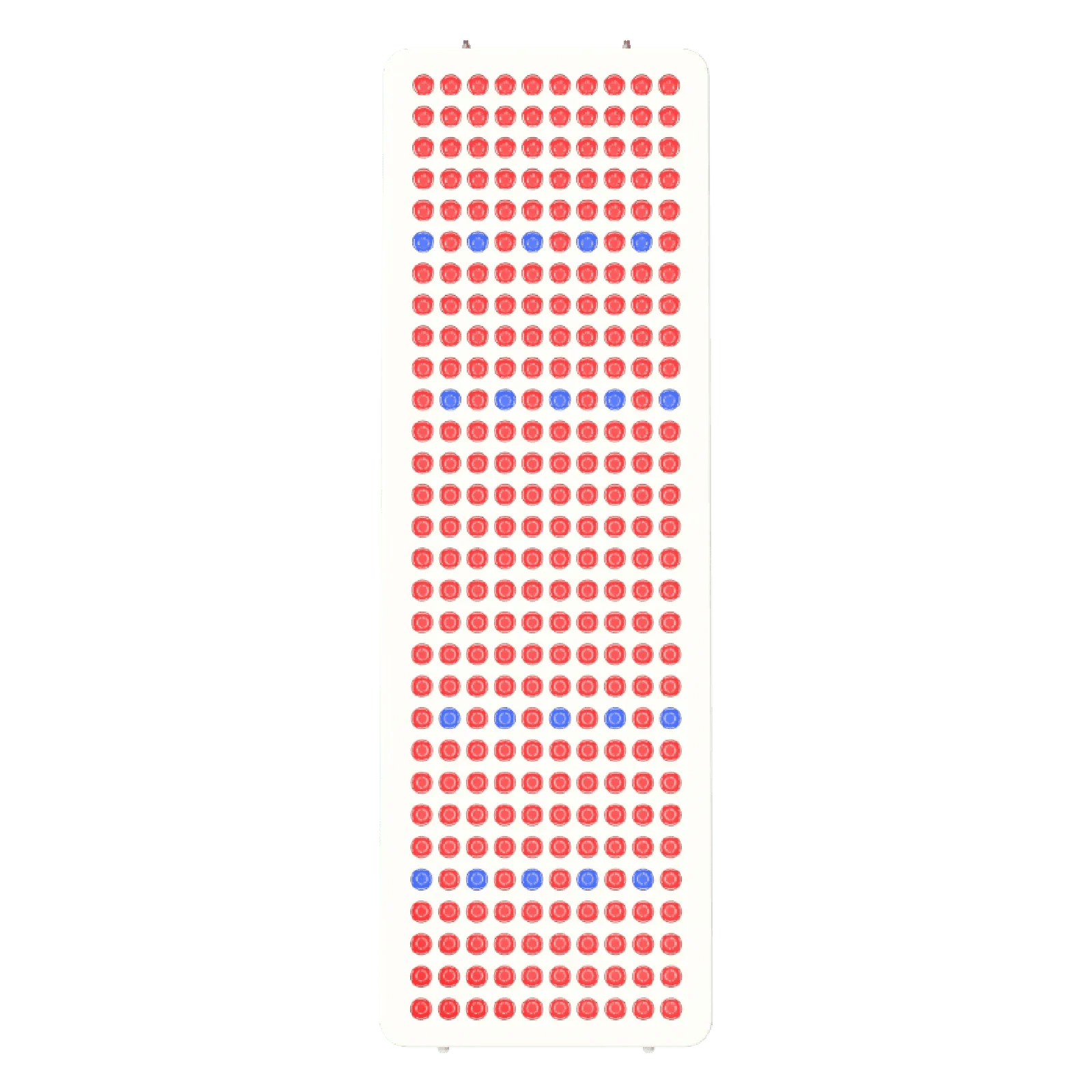
The phrase is misleading. Contemporary high-output panels are multi-wavelength devices, and only part of what they produce is red light you can see. Here is the published specification of the flagship panel in this range:
| Band | Wavelengths on the RDPRO1500-FS7 | Visible to you? |
|---|---|---|
| Blue | 480 nm | Yes |
| Red | 630 nm, 660 nm | Yes |
| Near-infrared | 810 nm, 830 nm, 850 nm | No |
| Deep near-infrared | 1060 nm | No |
Four of the seven wavelengths are invisible. The panel also publishes a peak irradiance of 131 mW/cm² at 15 cm and a power consumption of 463 W across 300 dual-chip LEDs. This is not a nightlight.
Why "it doesn't look that bright" is the wrong test
Your eyes have a genuine, built-in protection system. The International Commission on Non-Ionizing Radiation Protection (ICNIRP) describes it plainly: "Under normal circumstances, the pupil of the eye controls the level of light that reaches the retina. When this level is too high, a natural aversion response, such as squinting or blinking, occurs."
Read that carefully, because the mechanism has a dependency. The aversion response is triggered by perceived brightness. It is a response to what you can see.
ICNIRP's page on infrared radiation makes the same dependency explicit from the other direction: "Humans have inborn protective aversion responses to pain from high heat and to the bright light that is often also present." The two natural cues are heat pain and accompanying visible brightness.
Now consider an 850 nm or 1060 nm LED array. It is invisible, so it produces no perceived brightness of its own. At therapeutic distances it is not painfully hot on the skin, so there is no heat-pain cue either. Neither of the two natural triggers is doing much work — which means "I'd notice if it were too much" is not a safety mechanism, it is an assumption.
To be precise about what is and is not being claimed here. We are not telling you that red light therapy damages eyes — that is not what the evidence above establishes, and we will not overstate it. What the evidence establishes is narrower and more useful: the protective reflex people rely on is driven by visible brightness and heat, and a substantial part of these devices' output provides neither cue. That is a good reason to use the supplied eyewear rather than to rely on instinct.
The blue band is a separate consideration
Several panels in this range include 480 nm blue, and the RD7 and SNM7 masks are explicitly multi-colour devices spanning blue through red.
ICNIRP identifies photochemical retinal damage from short-wavelength visible light as a recognised hazard category: staring at very bright sources "for a longer time, will induce phototoxic reactions in the retina that can ultimately lead to loss of visual function in the affected areas. This is referred to as photochemical retinal hazard or blue light hazard."
That description concerns extreme sources such as the sun and welding arcs, not a wellness panel at working distance — and it would be dishonest to imply otherwise. It is relevant here for one specific reason: if your device has a blue mode, it is emitting in the band that safety standards treat as the photochemically active one, and that is the mode where eye protection matters most and where "eyes closed" is least sufficient.
What the manufacturer already told you
The clearest guidance is the one buyers overlook: the RDPRO1500-FS7 ships with "1 × Professional Eye Protection (Goggles)" in the box.
A manufacturer including eyewear as standard equipment is making a recommendation. It is not a bonus accessory, and leaving it in the packaging is a decision to ignore the instruction that came with the device. If your unit shipped with goggles, that is the answer to the question this article is about.
Eyewear, eyelids and distance
Closing your eyes is not equivalent to eyewear
Eyelids are thin, vascular tissue. They reduce transmitted light substantially but they are not an opaque barrier, and they are least effective at exactly the longer wavelengths that penetrate tissue best — which is the property near-infrared is selected for in the first place. Closed eyes are better than open eyes. They are not a substitute for proper eyewear.
What eyewear actually needs to do
Dark lenses are not automatically protective lenses. Tinted eyewear that blocks visible light while transmitting near-infrared is arguably worse than none, because it dims the visible cue that would otherwise make you squint while letting the invisible component through.
What to look for:
- Stated attenuation across the wavelengths your device emits — including the NIR bands, not just the red ones.
- Coverage, including from the sides. Light arriving off-axis still reaches the eye.
- The eyewear supplied with the device, in preference to generic sunglasses.
Distance does most of the work
Irradiance falls sharply with distance. The panel's 131 mW/cm² figure is quoted specifically "@ 15 cm" — a very close working distance. Doubling the distance reduces intensity substantially, which is why the treatment distance in your protocol is simultaneously a dosing decision and an exposure decision. Our guide to red light therapy dosage, distance and time covers the dosing side in detail.
Sensible practice
- Use the eyewear that came with the device. If none came with it, ask the manufacturer what they recommend for their specific wavelengths.
- Do not look directly into the LED array, at any distance, in any mode.
- Treat blue modes as requiring more care, not less, than red or NIR modes.
- Follow the manufacturer's stated distance and session time. They are the conditions the device was characterised at.
- Face masks sit directly against the face. Confirm the manufacturer's specific guidance on eye handling for that device rather than generalising from panel advice.
- Ask for the photobiological risk group. Lamp products can be classified for photobiological safety under the IEC 62471 framework; asking a manufacturer which risk group their product falls into, and on what testing, is a fair and revealing question.
- If you have an eye condition, are photosensitive, or take photosensitising medication, ask your clinician first. That is a medical question and it belongs with a medical professional, not a retailer.
Frequently asked questions
Do you need eye protection for red light therapy?
Use whatever the manufacturer supplies or specifies. Wellari's flagship panel, the RDPRO1500-FS7, includes professional eye protection goggles as standard equipment, which is the manufacturer's own answer for that device. The general reason is that these panels emit substantial invisible near-infrared alongside visible red, and the eye's natural aversion response is driven by visible brightness and heat — cues that invisible NIR does not provide.
Can I just close my eyes during red light therapy?
Closed eyes reduce exposure meaningfully but are not equivalent to proper eyewear. Eyelid tissue is thin and is least effective at attenuating the longer near-infrared wavelengths, which are chosen precisely because they penetrate tissue well. If eyewear was supplied, use it.
Is near-infrared light dangerous to the eyes?
We are not going to give you a yes or no, because the honest answer depends on the device, the irradiance, the distance and the duration — and a retailer asserting either extreme would be overstating what the evidence supports. What can be said clearly is that near-infrared is invisible, so it does not trigger the squint-and-blink response that ICNIRP describes as the eye's normal protection against excessive light. That is why the manufacturer's eyewear exists.
Are sunglasses good enough for red light therapy?
Generally no, and they can be counterproductive. Lenses that block visible light while transmitting near-infrared reduce the brightness cue that would make you look away while letting the invisible component through. Use eyewear with stated attenuation across your device's actual wavelengths, including the NIR bands.
Does blue light therapy need more eye protection than red?
Treat it with more care. ICNIRP identifies photochemical retinal damage from short-wavelength visible light — the "blue light hazard" — as a recognised hazard category. Several multi-wavelength devices in this range include a 480 nm blue mode, and that is the mode where eye protection matters most.
How far should I sit from a red light panel?
Follow the manufacturer's stated distance, which is also the distance their irradiance figure was measured at — the RDPRO1500-FS7's 131 mW/cm² is quoted at 15 cm. Intensity falls off sharply with distance, so the treatment distance is both a dosing decision and an exposure decision.
What is IEC 62471 and should I ask about it?
It is the international framework for assessing the photobiological safety of lamps and lamp systems, under which sources are assigned risk groups. Asking a manufacturer which risk group their product has been assessed as, and on what testing, is a reasonable question and the answer tells you something useful about how seriously they have approached the issue.
Where to go next
For protocol design, see our guide to dosage, distance and wavelength. If you are choosing between formats, compare panels, belts and masks or the wider panels versus beds versus wearables comparison. Our low-EMF and flicker testing guide covers another specification worth checking before you buy.
To browse hardware, see all red light therapy, the panels, or the facial masks.
One thing we will not do is tell you whether light therapy is appropriate for your eyes or your health. If you have an existing eye condition, photosensitivity, or take medication that increases light sensitivity, that conversation belongs with your clinician. We are happy to tell you exactly what a given device emits and what eyewear it ships with.
...)