
HBOT Oxygen Concentrator Requirements: Flow Rate, Purity and What Chambers Actually Need
Short answer: two numbers decide whether a concentrator suits a chamber — flow rate in litres per minute and oxygen concentration as a percentage — and they trade off against each other. Chambers in this range typically specify ≥10 L/min at ≥93%. If you are wondering why the spec says 93% rather than 99%, that is not a budget compromise: it is close to the physical ceiling of how these machines work.
The concentrator is the piece of the hyperbaric setup buyers think about last and understand least. It is usually presented as an accessory, when it is actually the component that determines whether the chamber can do what the specification says.
This guide covers what the chambers actually require, how concentrators produce oxygen, why purity has a hard limit, and the one specification trap that catches most buyers.
What the chambers in this range actually specify
| Chamber | Oxygen requirement | System power | Pressure |
|---|---|---|---|
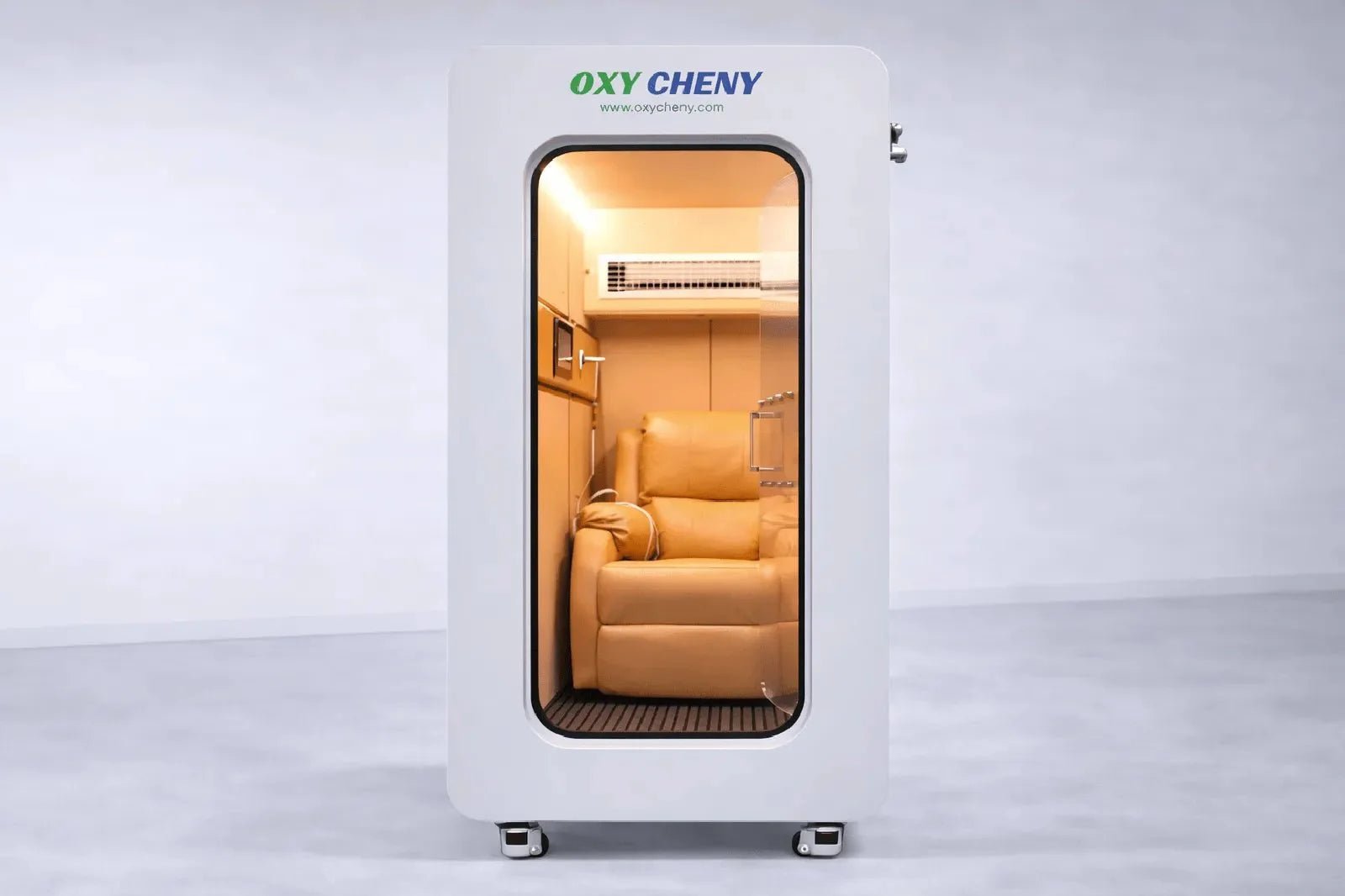
| CY5 Monoplace (hard-shell) | ≥10 L/min at 93% ±3 purity | 660 W integrated | 1.5 / 2.0 ATA |
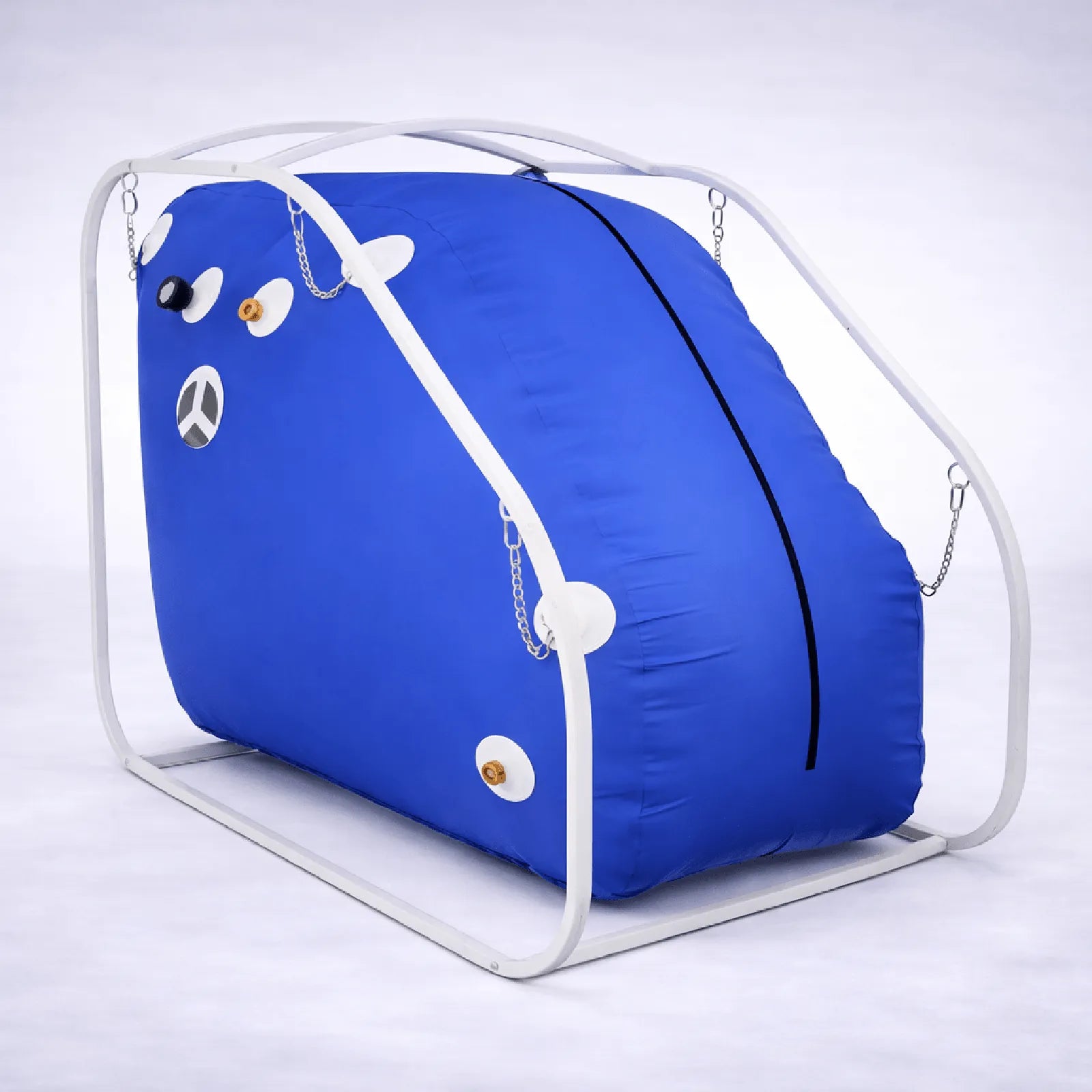
| CY9 Sitting (soft-shell) | Oxygen flow ≥10 L/min, concentration ≥93% | ≈850 W system power | 1.5 ATA / 50 kPa |
Note that both converge on the same pair of figures despite being completely different chamber formats. 10 L/min and 93% is the working specification to design around unless your specific model says otherwise — and the model's own documentation always governs.
How a concentrator actually makes oxygen
An oxygen concentrator does not store oxygen. It manufactures it continuously from room air, which is roughly 78% nitrogen, 21% oxygen and just under 1% argon.
The mechanism is pressure swing adsorption. Air is pushed through a bed of zeolite molecular sieve material that preferentially traps nitrogen; the oxygen-enriched remainder passes through as product gas, and the bed is then depressurised to release the captured nitrogen so the cycle can repeat. Research on medical concentrators describes exactly this — a review of flexible oxygen concentrators for medical applications characterises the process as a "PSA process with a nitrogen-selective adsorbent."
Two practical consequences follow immediately, and they explain most of what confuses buyers.
Why 93% and not 99%
The sieve is selective for nitrogen. Argon is not removed, because argon and oxygen behave too similarly on standard zeolite adsorbents. So as nitrogen is stripped out, the argon that was in the air concentrates along with the oxygen — and it sets a ceiling.
The same review notes that "medical-grade oxygen has oxygen concentration between 90 and 96% V/V with remaining nitrogen and argon," and reports achievable performance "in the range 93–95.7% and 1–15 L/min."
So the 93% on your chamber's spec sheet is not a lesser grade. It sits inside the normal band for medical-grade concentrator output, and a nitrogen-selective machine physically cannot reach the 99%+ figures people associate with bottled oxygen, because it is not removing the argon. If a listing advertises 99% purity from a room-air concentrator, that claim deserves a direct question about how it was measured and by what method the argon was removed.
The specification trap: flow and purity are not independent
This is the single most important thing on this page.
A concentrator's headline flow rate and its headline purity are often not achievable at the same time. Push most PSA machines toward their maximum flow and the sieve has less contact time per unit of air, so the output concentration falls. The same review illustrates the trade-off directly: the system it describes delivers 93–95.7% across 1–15 L/min, but a related configuration "produces 90% pure oxygen at a flow rate of 21.7 L/min" — more litres, lower percentage.
The buying consequence is precise: a machine advertised as "10 L/min" and separately as "93% purity" has not told you it delivers 93% at 10 L/min. Those may be two different operating points.
Ask for the purity at the flow rate you will actually run. That single question separates a concentrator that meets your chamber's spec from one that only appears to.
Continuous flow versus pulse dose
Concentrators come in two fundamentally different delivery modes, and only one of them is relevant here.
| Mode | How it delivers | Suitable for a chamber? |
|---|---|---|
| Continuous flow | Steady, uninterrupted output at the set L/min | Yes — this is what a chamber specification means |
| Pulse dose | Delivers a bolus triggered by the user's inhalation | No — designed for ambulatory use, not for feeding a chamber |
Small portable concentrators are very often pulse-dose machines, and their advertised "equivalent" numbers do not translate into continuous litres per minute. A chamber specifying 10 L/min means 10 L/min continuous. Portable travel units are generally the wrong class of machine for this job regardless of their headline figure.
Duty cycle: this machine runs for the whole session
A hyperbaric session is not a two-minute task. The concentrator runs continuously for the entire session, session after session, which puts it in a different reliability class from an occasional-use device.
Questions worth settling before purchase:
- Is it rated for continuous duty at the flow you need, or does it have a duty-cycle limit?
- What is the sieve bed service interval, and what does replacement cost? Sieve material degrades, particularly in humid environments.
- Does it have an oxygen purity sensor that alerts you when output drifts below specification? Purity falls gradually as sieve beds age, and without monitoring you will not notice.
- What filter maintenance does it require, and how often?
What it does to the room
The concentrator is a second appliance with its own demands, and it belongs in your site plan rather than as an afterthought.
- Power. It draws its own load, separate from the chamber. The CY9's system power is quoted at approximately 850 W and the CY5's at 660 W integrated — confirm with your supplier what is and is not included in those figures before an electrician sizes anything.
- Heat. A compressor running for an hour puts heat into the room, which matters in a small or poorly ventilated space.
- Noise. It runs for the entire session. Neither listing publishes a decibel figure; ask for one if the room adjoins a bedroom or a treatment space.
- Footprint and airflow. It needs clearance for intake and exhaust, and it cannot be boxed into a cupboard.
All of this belongs in the same conversation as the chamber itself — our hyperbaric chamber room requirements guide covers floor loading, access routes, ceiling height and clearance.
Oxygen enrichment is a fire-safety matter
A concentrator's entire purpose is to raise the oxygen concentration in an enclosed space, which is precisely the condition regulators warn about.
In its August 2025 letter to health care providers, the FDA advised readers to "ensure fire prevention and safety measures are followed for HBOT devices" and to "be aware that there is a heightened risk of fire with use of oxygen at a high concentration." It also recommended ensuring "proper grounding equipment is used" and following manufacturer instructions "to avoid potentially prohibited items during use of the HBOT device, including electrical or static devices."
Applied to the concentrator specifically: site it per the manufacturer's instructions, keep ignition sources out of the room, do not run it in an unventilated enclosed space, and treat the oxygen tubing route as part of the safety plan rather than as cable management.
Is a concentrator included with the chamber?
It varies by model, and it is worth confirming explicitly on your quote rather than inferring from a product listing. Some chambers in this category are supplied as complete systems with an oxygen source; others specify the oxygen requirement and expect it to be sourced separately. Because the two arrangements look similar in a summary, ask the direct question: does this price include an oxygen concentrator, and if so, what is its rated continuous flow and its purity at that flow?
If the answer does not include both numbers, you have not yet been told what you are buying.
Buying checklist
- Get your chamber's oxygen requirement from its own documentation — flow and concentration.
- Confirm the concentrator is continuous flow, not pulse dose.
- Ask for the purity at your required flow rate, not the two figures separately.
- Confirm it is rated for continuous duty for a full session length.
- Check whether it has a purity sensor and alarm.
- Establish sieve bed and filter service intervals and costs.
- Plan its power, heat, noise and footprint into the room.
- Confirm whether it is included in the chamber price.
- Confirm any regulatory or supply requirements that apply to medical oxygen equipment in your jurisdiction and for your intended use.
Frequently asked questions
What size oxygen concentrator do I need for a hyperbaric chamber?
Take the figure from your chamber's specification. Chambers in this range commonly require at least 10 L/min continuous flow at 93% or higher concentration — the CY5 specifies ≥10 L/min at 93% ±3, and the CY9 specifies ≥10 L/min at ≥93%. Confirm the concentrator delivers that purity at that flow rate.
Why is hyperbaric oxygen only 93% pure and not 99%?
Because concentrators work by adsorbing nitrogen out of room air, and the roughly 1% of argon in air is not removed — it concentrates alongside the oxygen. Published work on medical concentrators describes medical-grade oxygen as "between 90 and 96% V/V with remaining nitrogen and argon," with typical achievable output in the 93–95.7% range. A room-air concentrator advertising 99% warrants a direct question about measurement method.
Can I use a portable oxygen concentrator with a hyperbaric chamber?
Generally no. Most portable units are pulse-dose machines that deliver a bolus triggered by inhalation rather than a steady continuous flow, and their "equivalent" ratings do not convert to continuous litres per minute. A chamber specifying 10 L/min requires 10 L/min of continuous flow.
Does a higher flow rate mean lower oxygen purity?
Frequently, yes. Pushing a pressure swing adsorption machine toward maximum flow reduces contact time in the sieve bed and output concentration falls with it — published performance shows 93–95.7% across 1–15 L/min but 90% at 21.7 L/min in a related configuration. Always ask for purity at your working flow rate.
How long does an oxygen concentrator last?
The limiting component is usually the zeolite sieve bed, which degrades over time and more quickly in humid conditions. Service intervals and replacement costs vary by manufacturer, so ask for both before purchase. A unit with a built-in purity sensor will warn you when output drifts below specification; without one, degradation is invisible.
Does the oxygen concentrator need to be in the same room as the chamber?
It needs to reach the chamber, and it brings its own power draw, heat output, noise and airflow clearance. Plan it into the room alongside the chamber rather than treating it as an accessory, and follow the manufacturer's instructions on siting and ventilation given the fire-risk considerations of oxygen-enriched environments.
Is an oxygen concentrator included with a hyperbaric chamber?
That varies by model and by supplier. Ask explicitly whether one is included and, if so, for its rated continuous flow and its purity at that flow. Two chambers can look identically equipped in a summary and differ on this point.
Where to go next
Plan the room and the oxygen supply together — our chamber room requirements and site planning guide covers floor loading, access routes and fire-safety conditions for the space. For the chamber decision itself, see our comparison of hard versus soft shell chambers and the 2026 buyer's guide, and for session practicalities, HBOT at home: what to expect.
To compare hardware, browse all hyperbaric chambers, the hard-shell range or the soft-shell range.
On clinical questions: whether hyperbaric therapy is appropriate for you is a matter for a qualified clinician rather than a retailer. We can help you specify equipment correctly — send us your chamber model and we will confirm the oxygen requirement against its documentation.