
PEMF vs. Infrared Mats: Which Wellness Technology Is Right for You?
Wellness Mat Buyer’s Guide
PEMF and far-infrared mats are often marketed as though they do the same thing. They do not. Infrared mats create controlled warmth, while PEMF systems generate time-varying electromagnetic fields. This evidence-based guide explains how each technology works, what research does and does not support, how hybrid mats fit into a recovery routine, and which specifications matter before you buy.
Reviewed and updated: July 17, 2026 | Reading time: Approximately 16 minutes
Quick Answer
Choose infrared when your primary goal is warmth, relaxation, and temporary relief of muscle tension.
Consider PEMF when you specifically want a nonthermal electromagnetic modality and understand that evidence is highly device-, dose-, and condition-specific.
Choose a hybrid mat when you value both experiences and the manufacturer clearly discloses temperature range, PEMF frequency, field intensity, waveform, treatment area, safety instructions, and intended use.
Consumer wellness mats should not be assumed equivalent to prescription bone-growth stimulators or other FDA-authorized medical devices.
The Bioelectric Divide: Why Frequency and Heat Are Not the Same
Far-infrared mats and PEMF mats use different forms of energy. Infrared products emit electromagnetic radiation in the infrared portion of the spectrum, but their practical effect in a wellness mat is primarily thermal: the user feels warmth as the mat and body heat.
PEMF devices use coils or related components to generate electromagnetic fields that change over time. Depending on the system, the output is described by frequency, magnetic flux density, waveform, pulse duration, duty cycle, and coil geometry.
It is misleading to reduce the difference to “infrared soothes while PEMF heals.” Warmth can have meaningful effects on comfort and circulation, while PEMF has legitimate medical applications in very specific devices and indications. Neither technology produces every benefit claimed in consumer advertising.
| Factor | Infrared Mat | PEMF Mat |
|---|---|---|
| Primary output | Radiant and conducted heat | Time-varying electromagnetic field |
| What users feel | Warmth | Often little or no sensation |
| Main consumer use | Relaxation, warmth, muscle comfort | General wellness, relaxation, or device-specific applications |
| Key settings | Temperature, timer, heating area | Frequency, intensity, waveform, coil placement, timer |
| Evidence transfer | Sauna and heating-pad evidence does not automatically validate every mat | Prescription-device evidence does not automatically validate every consumer mat |
Infrared Mats: Controlled Thermal Energy for Relaxation and Comfort
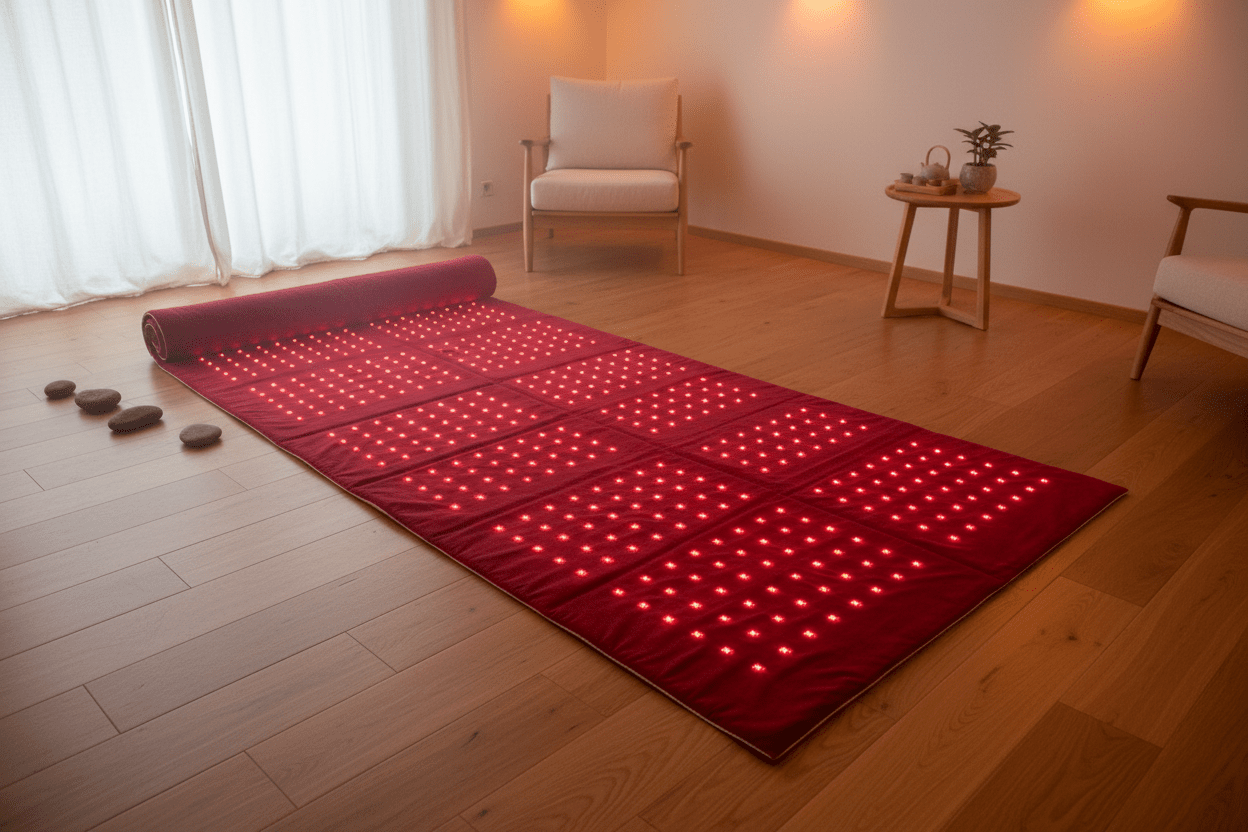
Infrared mats typically use heating elements beneath a padded surface. Some also include stones, ceramics, red-light LEDs, or other features. The user receives a combination of infrared radiation, direct conductive warmth, and trapped heat at the contact surface. For a broader comparison of home heat systems, read Wellari’s Home Sauna Buyer’s Guide: Infrared, Traditional & Hybrid.
Potential Benefits of Heat-Based Use
- Temporary relaxation of tight or sore muscles
- Comfort during a wind-down routine
- Temporary increases in local skin blood flow
- A passive recovery experience after activity
- Warmth without the space requirements of a sauna cabin
What Infrared Claims Often Get Wrong
Fixed statements that far-infrared energy penetrates exactly three or four centimeters should be treated cautiously. Energy absorption depends on wavelength, tissue composition, device output, distance, contact, and measurement method. In a mat, direct contact heating can contribute substantially to the sensation.
Infrared warmth also should not be advertised as detoxification of undefined toxins, permanent circulation repair, or deep cellular regeneration.
Heat Is a Real Modality Without Needing Exaggerated Claims
A comfortable mat can be useful because warmth feels relaxing and may temporarily ease muscle tension. Those benefits do not require claims about changing cellular voltage or flushing toxins.
PEMF Science: What Pulsed Electromagnetic Fields Actually Do
PEMF systems generate a magnetic field that switches, pulses, or changes according to a programmed waveform. A changing magnetic field can induce small electric fields in nearby conductive tissue. Biological effects depend on the complete signal—not frequency alone.
Research has investigated PEMF in bone healing, pain, osteoarthritis, rehabilitation, and other applications. Some prescription PEMF devices have FDA authorization for specific bone-healing indications. That does not mean every mat is FDA approved, clinically equivalent, or capable of treating fractures.
PEMF Is Not a Literal Battery Charger
“Recharging cells” is a marketing metaphor. Cell-membrane potential, ion transport, mitochondrial function, and signaling are complex processes. Consumer mats do not measure a user’s cellular voltage or prove that it has been restored.
There Is No Universal Biological Frequency Window
Research protocols vary widely in frequency, intensity, waveform, treatment time, and target tissue. A product offering 1–30 Hz may provide useful flexibility, but that range is not proof of medical effectiveness. Frequency without field intensity, waveform, duty cycle, and coil configuration is incomplete information. Buyers comparing electrical recovery technologies may also find Wellari’s TENS vs. NMES recovery guide useful because it explains why waveform, intensity, intended use, and device category matter.
What the Research Supports—and What It Does Not
The strongest PEMF evidence is tied to particular devices, protocols, and conditions. Reviews report potential value in some musculoskeletal applications, including selected pain conditions and bone healing, but results are heterogeneous.
Far-infrared research includes sauna systems, garments, lamps, and local heating devices. Evidence from these formats cannot automatically be transferred to a gemstone mat or low-temperature home pad.
| Claim | More Accurate Interpretation |
|---|---|
| PEMF repairs all cells | Selected PEMF devices and protocols have evidence for specific applications; broad cellular-repair claims are not established. |
| PEMF increases bone density by a fixed percentage | Bone studies vary by population, device, protocol, and endpoint. A single result should not be generalized to consumer mats. |
| Infrared penetrates deeply and detoxifies | Heat can affect comfort and circulation; detoxification claims are poorly defined and often unsupported. |
| NASA uses consumer PEMF mats | NASA-related research is frequently cited, but it does not validate every commercial wellness mat or its advertised outcomes. |
| Low frequency is always therapeutic | Frequency is only one signal parameter and does not establish efficacy by itself. |
Grounding vs. PEMF: Passive Conductivity and Active Field Generation
Grounding mats and PEMF mats are not interchangeable.
- Grounding mats create a conductive connection to electrical ground, usually through a grounded outlet or grounding rod.
- PEMF devices use electrical power to generate a changing magnetic field.
- Static magnet products generate a constant magnetic field and are not PEMF systems.
Grounding research remains preliminary, with small studies and significant methodological limitations. Claims about electron transfer, antioxidant effects, sleep, inflammation, or disease treatment require more rigorous evidence.
| Feature | Grounding Mat | Static Magnet Mat | PEMF Mat |
|---|---|---|---|
| Power required | Not usually for signal generation | No | Yes |
| Output | Conductive earth connection | Constant magnetic field | Pulsed or changing magnetic field |
| Main specification | Ground connection and electrical safety | Magnet strength and placement | Frequency, intensity, waveform, coils |
| Evidence | Preliminary | Limited for broad wellness claims | Condition- and device-specific |
Are Hybrid PEMF and Infrared Mats Worth It?
A hybrid mat can be appealing because the warmth is immediately noticeable while the PEMF program can run independently. The combination may make a relaxation routine easier to maintain, but evidence for a unique synergistic effect is limited. For readers building a broader recovery system, Wellari’s Ultimate Longevity Stack guide explains how infrared, cold therapy, HBOT, and red light may fit into a coordinated wellness routine.
Potential Advantages
- One device for heat and PEMF
- Independent or combined settings on some models
- Convenient full-body relaxation format
- May reduce equipment clutter
Potential Drawbacks
- Higher purchase price
- More components that may require service
- PEMF specifications may be incomplete
- Heat can mask whether PEMF creates any perceived difference
Wellari offers hybrid options through its red-light mats and blankets collection. The SNP200 Infrared PEMF Mat combines far-infrared heat, adjustable low-frequency PEMF settings, and 660 nm red-light LEDs in a compact format intended for general wellness. To understand how the red-light component differs from infrared heat, see How to Use Red Light Therapy for Daily Recovery and Red Light Therapy Devices Compared: Panel vs. Belt vs. Mask.
PEMF and Infrared Mat Specifications That Actually Matter
For PEMF
- Frequency range: How often the field pulses
- Magnetic flux density: Field strength, usually reported in gauss, microtesla, or millitesla
- Waveform: Sine, square, sawtooth, complex, or proprietary
- Coil count and placement: Determines field distribution
- Duty cycle and pulse duration: How long the field is active
- Program transparency: Whether the manufacturer explains what settings actually change
For Infrared Heat
- Maximum and minimum temperature
- Heating-zone coverage
- Warm-up time
- Timer and automatic shutoff
- Temperature control accuracy
- Surface materials and cleaning instructions
- Electrical certification and warranty
For the Complete Mat
- Dimensions, weight, and portability
- User weight limit
- Ability to operate features independently
- Return policy
- Warranty and replacement controller availability
- Contraindications and manufacturer support
- General-wellness vs. medical-device status
Which Mat Fits Your Goal?
| Primary Goal | Best Starting Point | Why |
|---|---|---|
| Warmth and muscle relaxation | Infrared or heated mat | Heat is the direct and noticeable mechanism. |
| Evening wind-down routine | Infrared or hybrid mat | Warmth can create a consistent relaxation cue. |
| Interest in low-frequency wellness technology | Transparent PEMF or hybrid mat | Choose a device that discloses more than frequency alone. |
| Diagnosed nonunion fracture | Clinician-prescribed medical device | Consumer wellness mats are not substitutes for indicated bone-growth stimulators. |
| Chronic pain condition | Clinical evaluation first | Pain has many causes; device evidence is condition-specific. |
| One device with multiple features | Hybrid PEMF-infrared mat | Convenient when each technology can be controlled independently. |
Safety, Contraindications, and Responsible Use
Ask a qualified clinician before using PEMF or significant heat if you are pregnant, have an implanted electronic device, have a seizure disorder, are receiving cancer treatment, have unstable cardiovascular disease, have impaired sensation, have difficulty regulating body temperature, or take medication that affects heat tolerance or blood pressure.
Heat Safety
- Start at a lower temperature and shorter duration.
- Do not sleep on an active heated mat.
- Avoid use when dehydrated, intoxicated, feverish, or acutely ill.
- Protect skin with reduced sensation from burns.
- Stop for dizziness, nausea, palpitations, weakness, or excessive discomfort.
PEMF Safety
- Follow the exact manufacturer instructions.
- Keep the controller and cables dry and undamaged.
- Do not assume a low-frequency setting is automatically appropriate.
- Ask the manufacturer about implanted-device compatibility.
- Do not use a wellness mat to self-treat a fracture or serious medical condition.
General-Wellness Equipment Is Not a Substitute for Medical Care
FDA authorization of a particular PEMF medical device for a particular indication does not authorize unrelated consumer mats for that use.
Illustrative Buying Case: Recovery and Evening Relaxation
Case type: Illustrative buyer-planning example—not a medical outcome or customer testimonial.
A healthy adult wants a mat for post-workout relaxation, evening warmth, and curiosity about low-frequency PEMF.
Poor Buying Approach
- Chooses the product with the largest list of medical claims
- Assumes 1–30 Hz guarantees clinical results
- Does not check heat range or mat dimensions
- Confuses an FDA-approved bone stimulator with a wellness mat
Stronger Buying Approach
- Defines the primary goal as relaxation and warmth.
- Treats PEMF as an optional general-wellness feature.
- Confirms independent heat and PEMF controls.
- Reviews frequency, intensity, coil placement, timer, warranty, and contraindications.
- Begins conservatively and tracks comfort rather than expecting a medical result.
Common PEMF and Infrared Marketing Myths
- “PEMF recharges every cell.” This is a metaphor, not a measured consumer outcome.
- “Infrared and heat are completely different.” Infrared mats create a thermal experience that also includes conductive heating.
- “NASA uses this exact mat technology.” NASA-related research does not validate every retail product.
- “1–50 Hz is the universal healing range.” Frequency alone does not define a therapeutic dose.
- “Static magnets are low-cost PEMF.” Static and pulsed magnetic fields are different.
- “Grounding and PEMF are the same.” One is a conductive connection; the other actively generates a field.
- “A mat can rebuild bone density.” Prescription bone-growth devices should not be conflated with consumer mats.
- “More heat is better.” Excess heat increases risk without guaranteeing additional benefit.
- “Feeling warmth proves deep healing.” Sensation does not establish tissue regeneration.
- “Hybrid always means synergy.” Convenience is clear; superior combined outcomes are not well established.
PEMF and Infrared Mat Buyer’s Checklist
- What is my primary goal: warmth, relaxation, PEMF experimentation, or clinician-directed care?
- Is the product a general-wellness device or a regulated medical device?
- Are PEMF frequency, field strength, waveform, and coil placement disclosed?
- Can heat and PEMF operate independently?
- What is the real heated area?
- What is the mat’s temperature range?
- Does it have a timer and automatic shutoff?
- Will the dimensions fit my body and room?
- How heavy is it to move or store?
- Are implanted-device and pregnancy warnings clear?
- What electrical certifications are listed?
- What does the warranty cover?
- Is the controller replaceable?
- Are return shipping and restocking fees clear?
- Does the seller provide real technical support?
Final Verdict
Infrared and PEMF mats solve different problems. Infrared provides controlled warmth and an immediately perceptible relaxation experience. PEMF provides a nonthermal electromagnetic input whose effects depend on the complete signal and the exact use.
For most home wellness buyers, the decision should begin with the experience they will actually use consistently. A hybrid mat can be a sensible choice when the heat system is well designed, the PEMF specifications are transparent, and the claims remain appropriate for general wellness. If you are planning an entire room rather than purchasing one device, review Wellari’s Complete Home Wellness Room Guide.
Explore Wellari’s infrared, red-light, and hybrid wellness mats or review the SNP200 portable hybrid mat.
Frequently Asked Questions
What is the main difference between PEMF and infrared mats?
Infrared mats primarily deliver heat. PEMF mats generate a time-varying electromagnetic field.
Is PEMF the same as infrared therapy?
No. They use different outputs and are described by different technical specifications.
Does PEMF heat the body?
Most low-intensity consumer PEMF systems are intended to operate without meaningful heating. Hybrid mats may add a separate heating system.
Are infrared mats the same as saunas?
No. A contact mat and a sauna cabin create different thermal environments.
Can PEMF recharge cells?
“Recharging” is a metaphor. Consumer mats do not measure or restore a user’s cellular voltage.
Are PEMF mats FDA approved?
Some specific PEMF medical devices are authorized for specific uses. A consumer wellness mat should not be assumed approved for those indications.
Does PEMF heal fractures?
Some prescription bone-growth stimulators are indicated for selected fractures or nonunions. Consumer mats are not substitutes for those devices.
Does NASA use PEMF?
NASA-related electromagnetic and tissue research is often cited, but it does not validate every consumer PEMF mat or marketing claim.
What PEMF frequency is best?
No single frequency is best for every goal. Frequency must be considered with field strength, waveform, pulse duration, coil placement, and protocol.
Is 1–30 Hz a good range?
It can provide adjustable low-frequency programs, but the range alone does not prove effectiveness.
Is PEMF better than infrared for pain?
That depends on the cause of pain, the device, and the protocol. Heat can provide temporary comfort, while PEMF evidence is condition-specific.
Are hybrid PEMF-infrared mats better?
They are more versatile, but a unique combined therapeutic advantage has not been established.
What is the difference between PEMF and grounding?
Grounding creates a conductive connection to earth; PEMF actively generates a changing magnetic field.
Are static magnets PEMF?
No. Static magnets create a constant field, while PEMF systems create a pulsed or changing field.
Can infrared mats detox the body?
Broad detox claims are poorly defined. The liver and kidneys perform the body’s primary detoxification work.
How hot should an infrared mat be?
Use the lowest comfortable setting consistent with the manufacturer’s instructions and your health status.
How long should a beginner use a mat?
Begin with a shorter session and conservative settings according to the product manual.
Can I sleep on a heated PEMF mat?
Do not sleep on an active heated mat unless the manufacturer explicitly permits that use and provides appropriate safety controls.
Can people with pacemakers use PEMF?
People with implanted electronic devices should obtain medical and device-manufacturer guidance before use.
Can pregnant people use PEMF or infrared mats?
Pregnancy is commonly listed as a reason to seek medical advice or avoid use.
What should I look for before buying?
Review intended use, technical specifications, safety warnings, independent controls, dimensions, warranty, return policy, and seller support.
Research and Further Reading
- Pulsed Electromagnetic Field Stimulation of Bone Healing and Joint Preservation
- Pulsed Electromagnetic Field Applications and Device-Specific Evidence
- Electromagnetic Field Therapy in Musculoskeletal Rehabilitation
- Current Evidence for PEMF in Osteoarthritis
- PEMF for Nonspecific Low Back Pain: Systematic Review
- Far-Infrared Therapy: Systematic Review
Compare Hybrid Wellness Mats
Wellari Wellness curates infrared, red-light, and PEMF-enabled mats for general relaxation and wellness routines, with clear specifications and product support.
Explore Wellness Mats View the SNP200 Hybrid MatWellari Wellness Editorial and Medical Disclaimer
Wellari Wellness provides general-wellness equipment and educational information. Unless expressly stated otherwise, products discussed here are not intended to diagnose, treat, cure, or prevent disease. Research involving prescription or clinical PEMF devices should not be applied automatically to consumer wellness mats.
This article is not medical advice. Consult a qualified clinician before using heat or electromagnetic wellness equipment if you have a medical condition, implanted device, pregnancy, seizure history, impaired sensation, cardiovascular concerns, or uncertainty about suitability.