
Perimenopause Recovery: Sauna, Cold Plunge & Red Light Therapy Explained
Women’s Midlife Recovery Guide
Perimenopause can change sleep, temperature regulation, mood, recovery, and exercise tolerance. Heat, cold, and red light may have a place in a personalized wellness routine, but they are not proven hormone-balancing treatments—and extreme protocols are not automatically better. This guide explains the evidence, uncertainties, safety considerations, and a more practical way to use recovery technology during the menopause transition.
Reviewed and updated: July 17, 2026 | Reading time: Approximately 18 minutes
Quick Answer
Sauna may support relaxation and general cardiovascular wellness, but research has not established a standard perimenopause sauna protocol or proven that it lowers cortisol, improves estrogen metabolism, or treats hot flashes.
Cold-water swimming surveys suggest that some women perceive improvements in mood and menopause symptoms, but these findings do not prove that cold immersion treats perimenopause.
Red and near-infrared light have evidence in areas such as skin rejuvenation and selected pain or recovery applications, but they have not been established as hormonal stabilizers or standard treatments for vasomotor symptoms.
The best starting point is a tolerable, trackable routine that does not worsen hot flashes, sleep, dizziness, palpitations, pain, or fatigue—and that does not delay evidence-based menopause care.
What Changes During Perimenopause?
Perimenopause is the transition leading up to menopause. Hormone levels can fluctuate, menstrual patterns may change, and symptoms can include hot flashes, night sweats, sleep disruption, mood changes, brain fog, headaches, joint discomfort, and changes in sexual or urinary health.
The experience is highly individual. Some women remain active with few symptoms; others have substantial disruption. The Menopause Society notes that vasomotor symptoms are common and may affect sleep, mood, and quality of life.
It is inaccurate to describe every woman in perimenopause as having a damaged stress-response system, chronically elevated cortisol, or “hormonal chaos.” Symptoms can be influenced by many factors, including sleep, thyroid disease, anemia, medications, mood disorders, cardiometabolic health, and life stress.
Perimenopause Is Not a Fitness Failure
Needing to adjust heat, cold, exercise, or recovery routines does not mean the body has stopped adapting. It means the dose may need to match current symptoms, health, conditioning, and goals.
Moving Beyond One-Size-Fits-All Recovery Protocols
Women historically have been underrepresented in parts of exercise and physiology research, and many popular recovery protocols are presented without enough attention to sex, age, menstrual status, medications, or menopause symptoms.
That does not mean every protocol developed in men is ineffective for women. It means results should not be generalized without considering differences in thermoregulation, body composition, cardiovascular response, training status, and symptom burden.
A better framework asks:
- What is the goal—relaxation, soreness management, sleep routine, mood, or performance?
- What does the person tolerate today?
- Does the session improve or worsen symptoms over the next 24 hours?
- Is the routine sustainable?
- Is a medical symptom being mistaken for a wellness problem?
Sauna Therapy During Perimenopause: Helpful, Harmful, or Both?
Sauna exposure raises skin temperature and heart rate and can create substantial thermal stress. Many people find it relaxing, but a person with active hot flashes or heat intolerance may find the same session uncomfortable.
There is not enough evidence to promise that sauna improves perimenopause sleep by a fixed percentage, lowers cortisol in every user, supports estrogen metabolism, or prevents muscle loss. Heat-shock proteins are a legitimate area of physiology research, but their activation does not prove a clinical anti-aging outcome.
Potential Reasons Women Use Sauna
- Quiet relaxation
- Temporary muscle comfort
- A post-exercise wind-down ritual
- General sauna-associated cardiovascular wellness
- Warmth during colder seasons
Why Sauna May Worsen Symptoms
- Heat can provoke or resemble a hot flash.
- Sweating may contribute to dehydration.
- Blood-pressure changes can cause dizziness.
- Late sessions may disrupt sleep in some users.
- Long or very hot sessions can add fatigue rather than relieve it.
| Sauna Type | Typical Experience | Perimenopause Consideration |
|---|---|---|
| Traditional sauna | Hotter air and lower-to-variable humidity | May feel intense for users with heat intolerance |
| Infrared sauna | Lower air temperature with radiant heat | Some users find it more tolerable; it is not inherently a menopause treatment |
| Steam room | High humidity and heat | Humidity can make cooling more difficult |
| Infrared blanket or mat | Contact or enclosed localized heat | Requires burn prevention and careful temperature control |
Compare formats in Wellari’s Home Sauna Buyer’s Guide, browse far-infrared saunas, or review full-spectrum infrared sauna options.
Cold Plunge and Cold-Water Swimming During Perimenopause
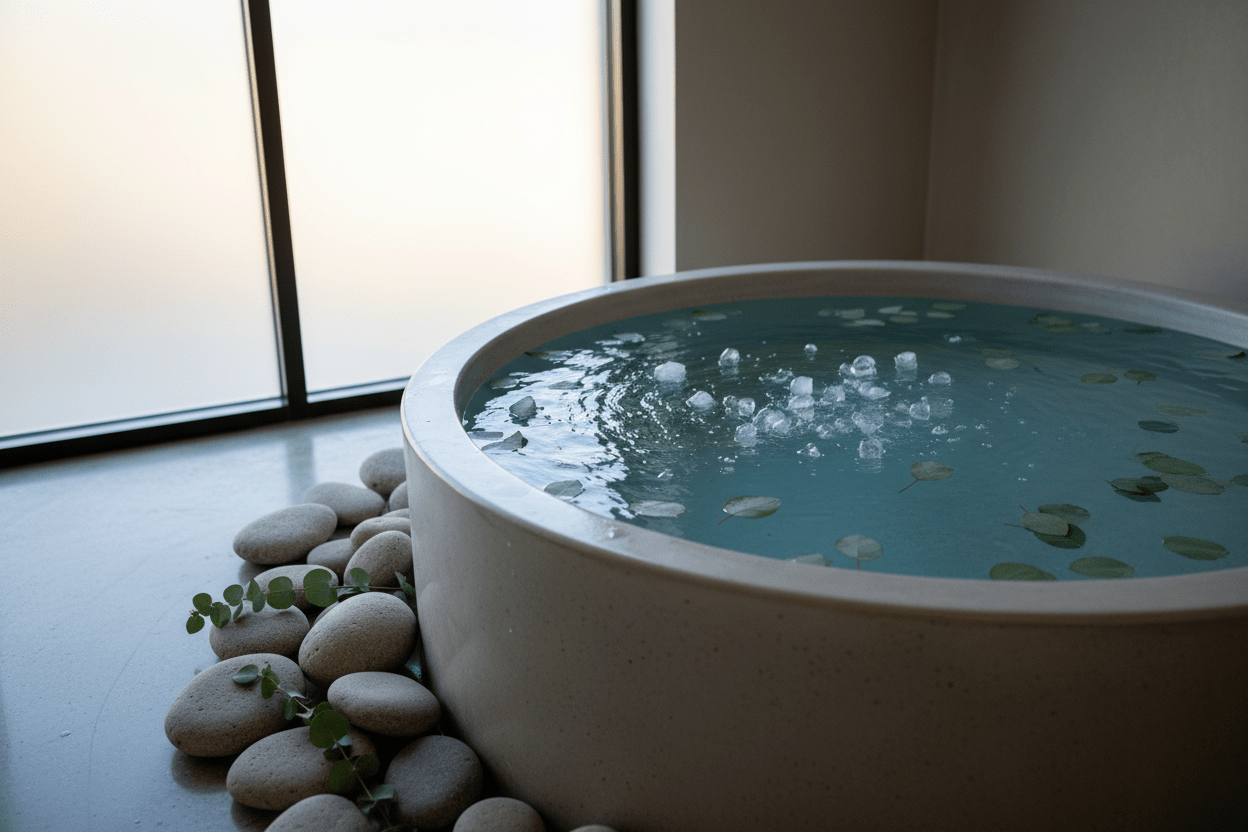
A 2024 survey of women who already participated in cold-water swimming reported perceived improvements in anxiety, mood swings, low mood, and hot flashes among some respondents. The findings are interesting, but the study was not a randomized treatment trial. Participants were self-selected swimmers, outcomes were self-reported, and social connection, outdoor activity, expectation, and exercise may have contributed.
A 2025 systematic review of cold-water immersion found possible time-dependent effects on stress, sleep, and quality of life, but emphasized that the evidence base remains limited by small trials and insufficient diversity.
No Universal Menopause Temperature Exists
There is no validated 60–68°F “sweet spot” for perimenopause. Water temperature, duration, body size, conditioning, environment, cardiovascular status, and habituation all influence the response.
No Proven Cycle-Phase Schedule Exists
There is insufficient evidence to prescribe cold exposure only during the follicular or ovulatory phases or to prohibit it during the luteal phase. Irregular cycles can also make phase-based scheduling impractical.
A More Conservative Progression
- Begin with cool—not painfully cold—water at the end of a shower.
- Keep the first exposure brief.
- Maintain normal breathing and an easy exit.
- Do not immerse alone outdoors.
- Warm gradually afterward.
- Increase only one variable at a time.
Cold Shock Is a Cardiovascular Stressor
Sudden immersion can sharply change breathing, heart rate, and blood pressure. People with cardiovascular disease, arrhythmia, fainting, uncontrolled blood pressure, cold urticaria, Raynaud’s symptoms, or other relevant conditions should seek medical guidance.
Red Light Therapy During Perimenopause
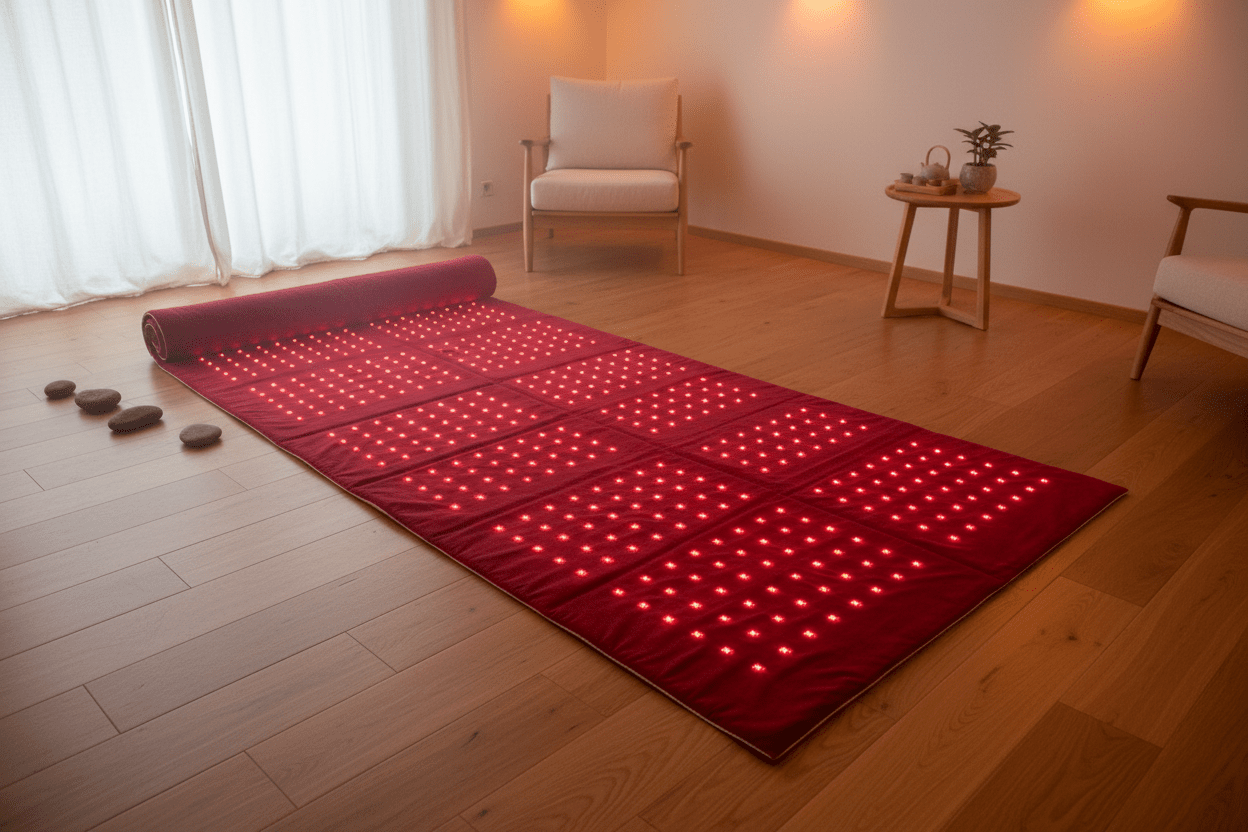
Red and near-infrared photobiomodulation use non-ionizing light at device-specific wavelengths and doses. Research has explored skin appearance, wound healing, pain, exercise recovery, and other applications.
It is reasonable for some women to choose red light because it does not create the same whole-body thermal load as sauna or cold immersion. However, red light should not be described as a “silent hormonal stabilizer.”
What Red Light May Support
- Selected skin-rejuvenation goals
- A low-exertion wellness routine
- Device-specific recovery or comfort applications
- A consistent self-care habit that does not require thermal extremes
What Is Not Established
- Direct regulation of estrogen or progesterone
- A validated sternal protocol for hot flashes
- Guaranteed reduction of vasomotor symptoms
- Correction of menopause-related mitochondrial dysfunction
- Replacement for hormone therapy or other evidence-based care
Learn how device format affects coverage and use in Red Light Panels vs. Beds vs. Wearables and Red Light Panel vs. Belt vs. Mask. You can also browse Wellari’s .
Contrast Therapy: Does Alternating Heat and Cold Help?
Contrast therapy alternates warm and cool exposure. It may feel invigorating or relaxing, but there is limited evidence for a menopause-specific contrast protocol.
The combined routine also increases complexity. Heat can contribute to dehydration and vasodilation; cold can provoke rapid vasoconstriction and a stress response. People who become dizzy or symptomatic should not treat the transition as a toughness test.
Potential Advantages
- Creates a structured recovery ritual
- Offers temperature preference and variety
- May feel refreshing after exercise
- Can be adjusted without extreme exposure
Potential Drawbacks
- Greater cardiovascular demand
- More difficult symptom attribution
- Potential dehydration and dizziness
- No proven menopause-specific superiority
For a broader comparison of technologies, read Wellari’s Ultimate Longevity Stack guide.
A Conservative Weekly Recovery Framework
The following schedule is an educational example—not a menopause treatment protocol. It assumes medical suitability and good tolerance.
| Day | Optional Routine | Decision Rule |
|---|---|---|
| Monday | Short, moderate infrared sauna | Stop if heat triggers dizziness or worsening hot flashes |
| Tuesday | Red light session according to device instructions | Use eye protection when required and avoid dose escalation |
| Wednesday | Rest, walking, mobility, or no device | Recovery does not require daily technology |
| Thursday | Brief cool shower or supervised cold exposure | Skip after poor sleep, illness, or concerning symptoms |
| Friday | Red light or gentle vibration routine | Choose the lower-stress option |
| Weekend | Optional heat, outdoor movement, or full rest | Base the choice on symptoms and schedule |
Progression Rules
- Introduce one modality at a time.
- Change only one variable per week.
- Avoid using maximum temperature or minimum water temperature as a goal.
- Track the following night’s sleep and next-day energy.
- Take a recovery week if symptoms accumulate.
Women interested in gentler nonthermal movement may also review Wellari’s guide to TENS vs. NMES recovery tools or explore whole-body vibration platforms.
Using HRV, Sleep, and Symptom Tracking Without Overinterpreting Data
Wearables can help identify patterns, but they cannot diagnose hormonal imbalance or determine the correct thermal dose.
Heart-rate variability is affected by breathing, sleep, exercise, alcohol, medication, illness, hydration, posture, and measurement method. A lower reading after cold exposure does not prove cortisol overload, and a higher reading after sauna does not prove parasympathetic repair.
Useful Metrics
- Sleep duration and awakenings
- Night-sweat frequency
- Hot-flash frequency and severity
- Morning energy
- Resting heart rate
- Exercise performance
- Dizziness, palpitations, headache, or unusual fatigue
- Consistency of the routine
Track Decisions, Not Just Numbers
Record the modality, settings, duration, time of day, and next-day response. The goal is to learn what is tolerable and useful—not to maximize a wearable score.
Where Wellness Technology Fits Beside Evidence-Based Menopause Care
Sauna, cold water, and red light are optional wellness practices. They should not replace evaluation for severe or disruptive symptoms.
The Menopause Society identifies hormone therapy as the most effective treatment for bothersome vasomotor symptoms for appropriate candidates. Nonhormonal prescription options and behavioral approaches are also available.
Consider Medical Evaluation for:
- Heavy, prolonged, or unusual bleeding
- New bleeding after menopause
- Severe or persistent hot flashes
- Major sleep disruption
- Chest pain, fainting, or significant palpitations
- Depression, anxiety, or changes in mental health
- New neurologic symptoms
- Symptoms that could reflect thyroid disease, anemia, or another condition
Safety and Contraindications
Ask a Clinician Before Sauna or Heat Exposure If You Have:
- Unstable cardiovascular disease or uncontrolled blood pressure
- Frequent fainting or significant dizziness
- Kidney disease or fluid restrictions
- Impaired sweating or heat intolerance
- Medication that affects blood pressure, alertness, or thermoregulation
- Pregnancy or possible pregnancy
Ask a Clinician Before Cold Immersion If You Have:
- Heart disease, arrhythmia, or uncontrolled hypertension
- Raynaud’s phenomenon or cold urticaria
- Seizure disorder
- Fainting history
- Asthma triggered by cold
- Pregnancy or possible pregnancy
Red Light Precautions
- Follow device-specific distance and time instructions.
- Use eye protection when required.
- Ask about photosensitizing medications or conditions.
- Do not shine devices over suspicious lesions instead of seeking evaluation.
- Do not assume more exposure produces better results.
Buying Recovery Equipment for Perimenopause
Sauna Checklist
- Temperature control and lower-setting flexibility
- Easy exit and seating
- Electrical and room requirements
- Ventilation
- Warranty and service
- Clear contraindications
Cold Plunge Checklist
- Precise temperature control
- Stable steps and hand support
- Easy emergency exit
- Filtration and sanitation
- Cover, drainage, and maintenance
- Location that avoids solo exposure risk
Red Light Checklist
- Published wavelengths
- Irradiance at a stated distance
- Coverage area
- Timer and independent wavelength controls
- Eye-safety guidance
- Warranty and replacement support
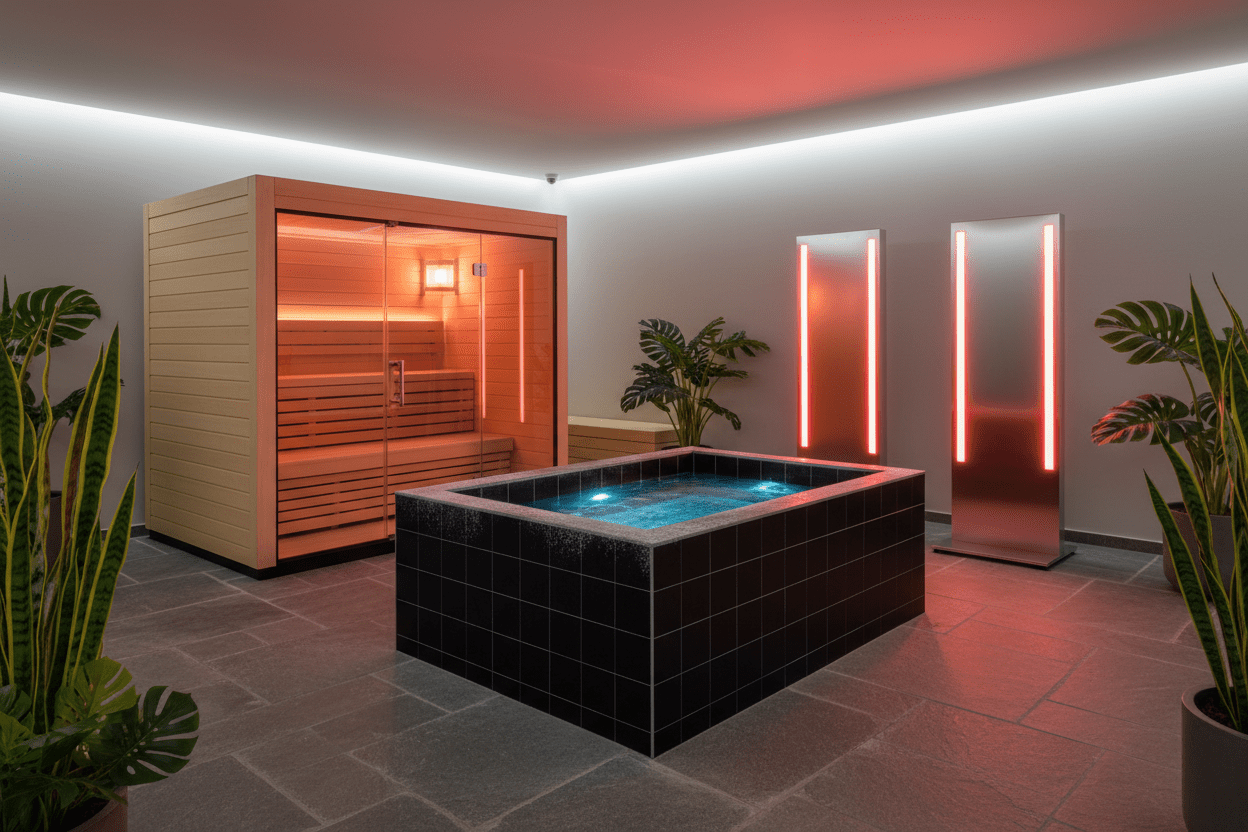
Planning a complete room? Read Design Your Dream Home Wellness Room before purchasing multiple systems.
Illustrative Case: Adjusting Recovery During Perimenopause
Case type: Illustrative planning example—not medical advice or a customer outcome.
An active woman in her late 40s notices more night sweats, occasional dizziness after workouts, and poorer sleep. She wants to add sauna, cold plunge, and red light at once.
Poor Approach
- Starts three modalities during the same week
- Uses maximum sauna heat
- Chooses near-freezing water as a resilience challenge
- Attributes every symptom to hormones without medical review
- Uses HRV as proof that the protocol is working
Stronger Approach
- Discusses dizziness and bleeding history with a clinician.
- Starts with a short, moderate sauna session once weekly.
- Tracks hot flashes, hydration, sleep, and next-day fatigue.
- Adds red light separately after tolerance is clear.
- Experiments with a brief cool shower rather than extreme immersion.
- Stops any modality that worsens symptoms.
Common Perimenopause Recovery Myths
- “All longevity protocols were designed for men.” Research gaps exist, but this statement is too broad.
- “Perimenopause always means high cortisol.” Cortisol patterns are not uniform and cannot be diagnosed from symptoms alone.
- “Infrared sauna lowers cortisol and balances estrogen.” These are not established universal outcomes.
- “Cold plunge should be avoided in the luteal phase.” No validated rule supports this for every woman.
- “60–68°F is the female cold-plunge zone.” There is no standard menopause-specific temperature.
- “Sternal red light reduces hot flashes by 30%.” This is not established by robust clinical evidence.
- “Red light balances hormones.” It is not a standard hormone treatment.
- “Contrast therapy controls cortisol.” Acute responses vary and are not reliably inferred from feeling relaxed.
- “More discomfort means more adaptation.” Excess dose can increase risk and reduce adherence.
- “Wearables reveal hormonal readiness.” HRV and sleep data are indirect and nonspecific.
Frequently Asked Questions
Is sauna safe during perimenopause?
Many healthy women tolerate sauna, but heat intolerance, dizziness, cardiovascular conditions, medications, and dehydration can affect safety.
Can sauna help hot flashes?
Evidence is not strong enough to recommend sauna as a standard hot-flash treatment. Heat may improve comfort for some users and worsen symptoms for others.
Is infrared sauna better than traditional sauna for perimenopause?
Some users prefer the lower air temperature of infrared sauna, but it has not been proven universally superior for menopause symptoms.
Does sauna lower cortisol?
Cortisol responses vary with protocol, timing, health, and measurement. Sauna should not be assumed to lower cortisol in every user.
Can sauna balance estrogen?
No. Sauna is not an established treatment for estrogen deficiency or hormonal imbalance.
Can cold-water swimming reduce menopause symptoms?
Survey participants reported perceived benefits, but controlled trials are needed to establish treatment effects.
What temperature should a perimenopausal woman cold plunge at?
No menopause-specific temperature has been validated. Begin conservatively and obtain medical guidance when relevant.
Should cold plunges be avoided before a period?
There is no universal evidence-based rule. Individual symptoms and tolerance are more useful than a fixed cycle schedule.
Does cold exposure raise cortisol?
Cold is an acute stressor and can affect stress hormones, heart rate, and blood pressure. The response varies.
Can cold plunging improve hot flashes?
Some women report improvement, but cold immersion is not an established hot-flash treatment.
Does red light therapy balance hormones?
No standard red-light protocol has been proven to balance reproductive hormones.
Can red light therapy reduce hot flashes?
Evidence is insufficient to recommend consumer red-light devices as a treatment for hot flashes.
Is red light safer than sauna during perimenopause?
Red light generally creates less whole-body heat, but device-specific eye, skin, medication, and dose precautions still apply.
Can I use sauna, cold plunge, and red light on the same day?
Some people do, but combining modalities increases physiological load and makes side effects harder to attribute. Introduce them separately.
What is gentle contrast therapy?
It generally means alternating tolerable warmth and cool exposure rather than extreme heat and near-freezing water.
Can HRV tell me when to use a cold plunge?
HRV may provide context, but it cannot determine hormonal readiness or guarantee that cold exposure is appropriate.
What is the best recovery tool for poor sleep?
The answer depends on the cause. Treating hot flashes, sleep apnea, insomnia, mood symptoms, or medication effects may matter more than a device.
Should I skip thermal therapy after poor sleep?
A shorter or lower-intensity session—or rest—may be more appropriate when exhausted, ill, or symptomatic.
Can perimenopausal athletes use sauna and cold plunges?
Yes, when medically appropriate and individualized to training, symptoms, hydration, and recovery.
When should I see a menopause specialist?
Seek care when symptoms are disruptive, bleeding is unusual, or you want to discuss hormone and nonhormonal treatment options.
What should I buy first?
Start with the modality most closely matched to a clear goal and likely to be used consistently. Avoid buying multiple systems before testing tolerance.
Research and Authoritative Sources
- The Menopause Society: Perimenopause
- The Menopause Society: Hot Flashes and Night Sweats
- The Menopause Society: Hormone Therapy
- National Institute on Aging: What Is Menopause?
- Cold-Water Swimming Habits and Self-Reported Menopause Symptoms
- Cold-Water Immersion and Health: 2025 Systematic Review
- Local Far-Infrared Thermal Therapy and Menopausal Symptoms
- Red Light Photobiomodulation and Visible Skin Aging
Build a More Personalized Recovery Routine
Wellari Wellness helps home users and professional facilities compare sauna systems, cold therapy, red light devices, vibration platforms, and other recovery technologies with clear specifications and long-term support.
Explore Sauna Options Explore Red Light TherapyWellari Wellness Editorial and Medical Disclaimer
Wellari Wellness provides general-wellness equipment and educational information. Products discussed in this article are not intended to diagnose, treat, cure, or prevent menopause, hormonal disorders, hot flashes, or disease unless expressly authorized and labeled for a specific medical use.
This article is not medical advice and does not replace care from a qualified clinician. Seek individualized guidance before using thermal or light-based equipment if you have cardiovascular disease, blood-pressure concerns, pregnancy, medication-related heat sensitivity, fainting, cold-triggered conditions, photosensitivity, or other medical concerns.