
Cold Plunge Chiller Sizing: How to Match Cooling Capacity to Your Tub
Short answer: horsepower will not tell you what size chiller you need. In this catalogue alone, a 1.25 HP unit is rated for baths up to 1000 litres while a 4 HP unit is rated for 800 litres — because they are built for different duties, not different sizes. Size on water volume, target temperature, ambient temperature and how fast you need to get there, then ask the manufacturer for cooling output in watts or BTU/hr at a stated water temperature.
Chiller listings are one of the least standardised corners of the recovery market. Some manufacturers publish horsepower. Some publish watts. Some publish a litre capacity and nothing else. None of those three numbers measure the same thing, and buyers routinely compare them as though they did.
This guide is about the engineering question underneath the spec sheet: how much heat you actually need to remove, what makes that number move, and how to read the ratings that manufacturers publish. If you already know your capacity requirement and want to compare specific units on features, noise and smart control, our 2026 cold plunge chiller comparison is the product-by-product resource.
Why horsepower is the wrong first question
Horsepower describes a compressor's mechanical rating. It does not describe how much heat the system removes from your water, which depends on the refrigerant circuit, the heat exchanger, the ambient conditions it was rated in, and the target water temperature.
The clearest possible demonstration sits inside this catalogue. Compare two units:
| Unit | Published rating | Rated volume |
|---|---|---|
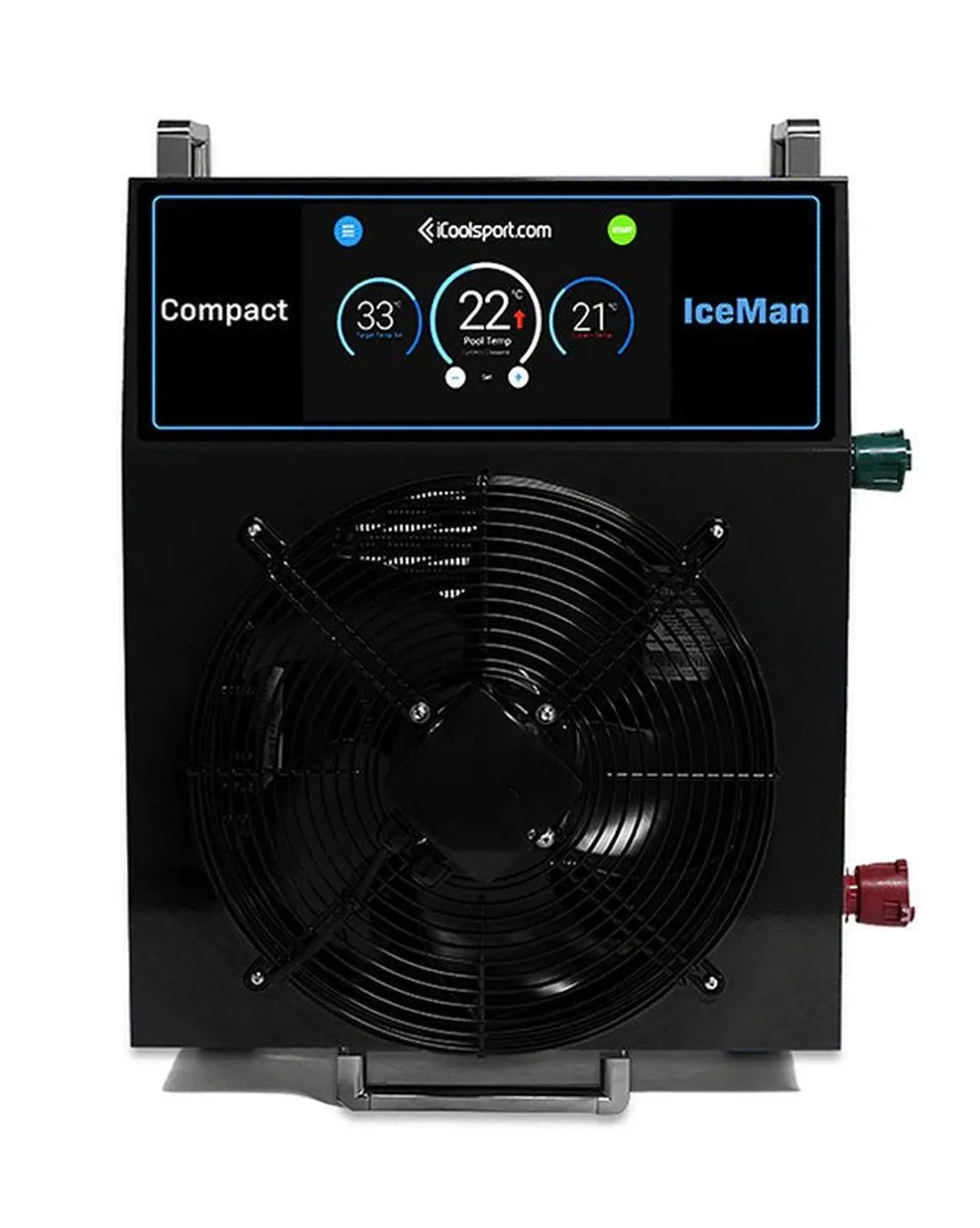
| iCool Iceman | 1.25 HP | Pools up to 1000 L |
| Ultra Cedar External | 4 HP / 10,000 W | 800 L capacity |
The higher-horsepower unit is rated for the smaller volume. That is not an error in either listing. It reflects that the two products are solving different problems: one is a portable chiller sized to hold a personal bath cold, the other is a high-output system built to pull a group bath down fast and recover between users. Volume rating encodes an assumed duty, and the duty is rarely stated.
A note on the watt figures. One horsepower is 745.7 watts, so a 4 HP compressor's mechanical rating is roughly 3 kW — which means the 10,000 W quoted alongside it is describing a different quantity, most plausibly cooling output rather than shaft power. We are not going to guess which. If a watt figure is the number you intend to compare across brands, ask the manufacturer in writing whether it is input power or cooling output, and at what water and ambient temperature it was measured. Without those conditions attached, a watt figure is not comparable to another brand's watt figure.
The number that actually matters: heat load
Cooling water is a physics problem with a definite answer. Removing heat from water takes a fixed amount of energy per degree, and that quantity is set by water's specific heat capacity — approximately 4.186 kJ per kilogram per °C, as tabulated by the Engineering ToolBox reference on water properties. In imperial terms, one BTU raises one pound of water by one °F, and a US gallon of water weighs about 8.34 lb.
A worked example
Take a 400 litre (about 106 US gallon) plunge, filled at 21 °C / 70 °F, that you want at 7 °C / 45 °F.
- Metric: 400 kg × 4.186 kJ/kg°C × 14 °C = 23,442 kJ, or about 6.5 kWh of heat to remove.
- Imperial: 106 gal × 8.34 lb × 25 °F = 22,100 BTU, which is the same 6.5 kWh expressed differently.
That figure is the minimum. It assumes a perfectly insulated tub losing nothing to the room, which does not exist. Real pull-down also has to overcome heat flowing in continuously from the air, the ground, the plumbing and the circulation pump itself.
The practical consequence: a chiller's rated output tells you how long pull-down takes, and the tub's insulation tells you how hard the chiller has to work to keep it there. They are two different jobs, and a unit can be good at one and mediocre at the other.
Pull-down and hold are different duties
| Duty | What it asks of the chiller | What dominates |
|---|---|---|
| Pull-down — taking a fresh fill from ambient to target | High output for a sustained period | Cooling capacity, water volume, starting temperature |
| Hold — keeping it at target between sessions | Enough output to match heat gain, cycling on and off | Insulation, lid quality, ambient temperature, pump runtime |
| Recovery — re-cooling after a user has warmed the water | Rapid output on demand | Capacity headroom, number of users per session |
A single-user home plunge that lives indoors under a good insulated cover spends most of its life on the hold duty, where a modest chiller is entirely adequate. A tub in a garage in a warm climate, used by four people back to back, spends its life on recovery, where the same chiller will feel permanently behind.
The five variables that move your requirement
- Water volume. The single largest term. Doubling the volume doubles the energy required for the same temperature change.
- Temperature delta. Not just your target, but your starting point. A tub filled from a cold tap in winter is a much smaller job than the same tub filled in August.
- Ambient temperature. This drives continuous heat gain and also degrades the chiller's own efficiency — refrigeration systems reject heat to the surrounding air, so a hot garage hurts twice.
- Insulation and lid. The cheapest capacity you will ever buy. An insulated tub with a well-fitted cover reduces hold-duty demand substantially; an uninsulated tub with a loose cover turns a hold problem into a continuous pull-down problem.
- Users and turnover. Every person entering the water adds heat. One user daily and a team of six in an hour are different machines.
Placement is part of sizing. Where the unit lives affects both heat gain into the tub and the chiller's ability to reject heat. Our cold plunge setup guide for garage, backyard and indoor installations covers clearance, drainage and siting, all of which change the answer here.
How manufacturers actually publish capacity
Here is how the units in this range describe themselves — presented exactly as published, precisely so the inconsistency is visible.
| Unit | Capacity as published | Temperature published |
|---|---|---|
| iCool Compact Series 5 | 5000 W, baths up to 500 L | Reaches 4 °C (39 °F) |
| iCool Iceman | 1.25 HP, pools up to 1000 L | Lowest temperature 5 °C (41 °F) |
| iCool Compact XP Dual-Temp | 3.1 HP, pools up to 3000 L | Cooling and heating |
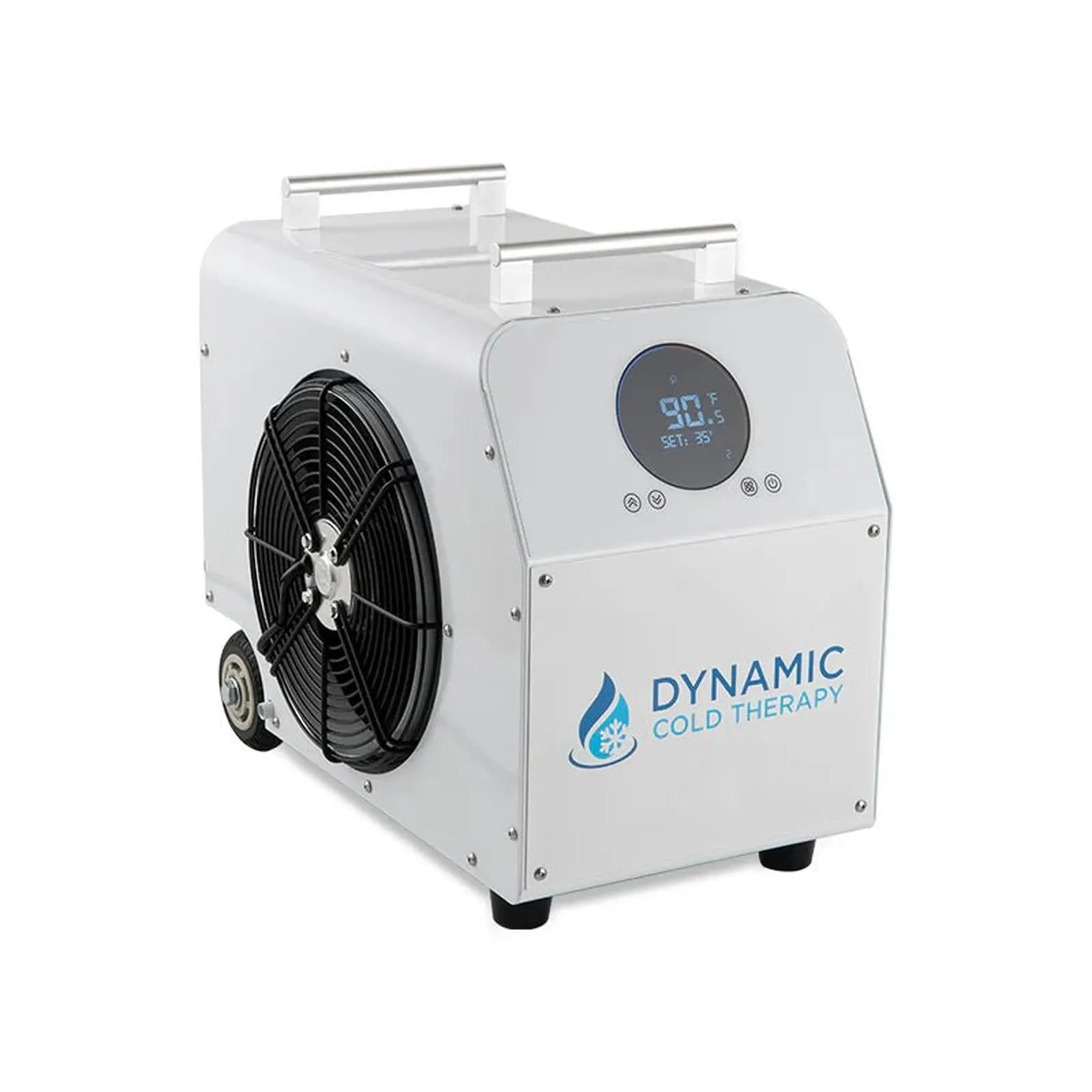
| Dynamic Premier 1.0 HP | 1.0 HP — no volume rating published | 37 °F–85 °F |
| Dynamic Standard 0.8 HP | 0.8 HP — no volume rating published | 37 °F–107 °F |
Three different rating conventions across five products. Two of them publish a litre capacity; two publish only horsepower and leave the volume question unanswered. Watts, horsepower and litres are not interchangeable, and a unit with no published volume rating has not told you what duty it was designed for. That is the question to put to a supplier before you buy, and it is a reasonable question that a good one will answer.
How to size, in order
- Establish your water volume from the tub's specification, not from eyeballing it.
- Decide your target temperature and your realistic worst-case fill temperature. Our guide to the ideal cold plunge temperature covers where most people actually settle. Check it against the unit's lowest published temperature — the two chillers above bottom out at 4 °C and 5 °C respectively.
- Calculate the heat load using the worked example above. This gives you the energy figure; it is the floor.
- Decide which duty dominates — hold, or repeated rapid recovery. Be honest about user count.
- Add margin for ambient. An outdoor or garage installation in a warm climate needs headroom that an indoor one does not.
- Then compare units on published output at a stated temperature, and treat any figure without stated conditions as a marketing number rather than a specification.
Where filtration and sanitation fit
Sizing decisions interact with water care. A chiller running a continuous circulation loop adds a small, constant heat input from the pump, which is part of your hold-duty load. Systems that integrate ozone or filtration keep water usable for longer between changes, which changes how often you face a full pull-down from ambient. Our comparison of ozone versus UV-C filtration and the assessment of whether self-cleaning plunges justify their cost over ice both bear on that.
Frequently asked questions
What size chiller do I need for a cold plunge?
It depends on water volume, your target temperature, your fill temperature, ambient conditions, insulation and how many people use it. Calculate the heat load first — volume in kilograms multiplied by 4.186 kJ multiplied by the temperature drop in °C — then match that against a chiller's published cooling output at a stated water temperature. Horsepower alone will not answer the question.
Is a 1 HP chiller enough for a home cold plunge?
For a single-user, well-insulated, indoor tub held at temperature under a fitted cover, a unit in this class is a common residential choice. For an uninsulated or outdoor tub in a warm climate, or for several users in quick succession, the same unit will spend far more time running and take longer to recover. The duty matters more than the horsepower figure.
How long should a chiller take to cool a cold plunge?
That is a function of heat load divided by cooling output, plus ongoing heat gain. Our worked example shows a 400 L tub dropping 14 °C requires about 6.5 kWh of heat removal as a theoretical minimum. Real pull-down always takes longer, because the tub is gaining heat from the room the entire time. Ask the manufacturer for a pull-down time at a stated volume and ambient temperature.
Why do two chillers with the same horsepower cool differently?
Because horsepower is a compressor rating, not a measure of delivered cooling. Heat exchanger design, refrigerant circuit, flow rate and the conditions the unit was rated under all change the actual output. This is also why a higher-HP unit can carry a lower rated volume than a lower-HP one, as two products in this range demonstrate.
Does insulation really change what chiller I need?
Substantially, for the hold duty. Insulation and a well-fitted cover reduce the rate at which heat flows back into the water, which is the load your chiller works against between sessions. It does not change the energy needed for the initial pull-down, but it changes how much of the time your chiller has to run.
Do I need a bigger chiller for outdoor installation?
Generally yes, and for two reasons. Warmer ambient air pushes more heat into the tub, and refrigeration systems reject their waste heat into that same air, so efficiency falls exactly when demand rises. Build in headroom for the hottest month, not the average.
Can I use a chiller rated for a larger volume than my tub?
Oversizing generally shortens pull-down and leaves headroom for recovery. The trade-offs are purchase cost, physical footprint, noise while running and shorter compressor cycles. Confirm minimum flow and volume requirements with the manufacturer, since some units specify a lower bound as well as an upper one.
Where to go next
Once you know the capacity you need, the 2026 chiller comparison covers specific units on noise, smart control and features. Before your first session, please read cold plunge safety and heart health — cold immersion is not appropriate for everyone, and that is a conversation to have with your clinician.
To browse hardware, see the cold plunge chillers, the cold plunge tubs, or the full cold therapy range.
Not sure which duty your setup falls into? Tell our team your tub volume, where it will live and how many people will use it, and we can work the sizing through with you.