
Sauna Heater Types Explained: Carbon, Ceramic and Full Spectrum
Short answer: the emitter is the sauna. It sets the wavelength you receive, how long the cabin takes to warm, how evenly the heat lands, and how much magnetic field you sit next to. Carbon panels are large, cool-running far-infrared surfaces. Ceramic elements run hotter and smaller. Full-spectrum cabins add a separate near-infrared element — and by the manufacturer's own measurements, that element carries several times the EMF of the carbon panels around it.
Sauna listings tend to describe wavelength as though it were a setting: near, mid, far, full spectrum. It isn't a setting. It is a consequence of what the heater is made of and how hot its surface runs. Two cabins with identical dimensions and identical wood can deliver noticeably different heat because they use different emitters.
This guide explains what actually separates carbon, ceramic and full-spectrum heating — the physics underneath, the trade-offs that follow from it, and what the cabins in this category actually use.
The one rule that governs every infrared heater
All infrared emitters do the same basic thing: pass current through a resistive material, get it hot, and let it radiate. What differs is surface temperature — and surface temperature determines wavelength.
The relationship is fixed and well established in industrial heating. The infrared element manufacturer Ceramicx states it directly in its reference on the laws of infrared heating: "shorter peak emission wavelengths are achieved by using emission sources with higher surface temperatures." Cooler surface, longer wave. Hotter surface, shorter wave.
That single relationship explains everything else on this page.
| Emitter class | Published figures | What that means |
|---|---|---|
| Ceramic elements | Operate up to 750 °C (1382 °F), producing wavelengths in the 2–10 micron range; roughly 10–12 minutes to reach steady-state temperature | Long-wave output from a relatively hot, compact element |
| Quartz tungsten | Peak emission wavelength of approximately 1.6 microns | Medium wave — a much hotter source, much shorter wave |
| Quartz halogen | Can reach temperatures as high as 2600 °C | Short wave — the extreme end of the same rule |
Where these figures come from, and what they are not. Every figure above is quoted from Ceramicx, a manufacturer of industrial infrared heating elements, and each links to the page that publishes it. They describe emitter classes in industrial heating — not sauna cabins. They are included because the underlying physics does not change with the application. Individual sauna heaters are engineered to their own specifications, and no cabin manufacturer in this category publishes a peak-wavelength figure per model. Treat any sauna listing that quotes an exact micron figure without naming its measurement method with appropriate caution.
Carbon panels: large area, low temperature
Carbon heaters are flat panels rather than rods or tubes. Because the heating area is large, a carbon panel can deliver its rated wattage while staying comparatively cool at the surface — and a cooler surface is what places the output firmly in the far-infrared range.
Three practical consequences follow, and they are the reason carbon dominates the residential cabin market:
- Coverage is even. A panel radiating across a broad face produces fewer hot spots than a small, intense element. Sit against a carbon wall and the heat arrives across your back rather than at a point.
- The surface is tolerable to touch-adjacent contact. Bench and backrest layouts can sit closer to a panel than to a high-temperature element.
- Low surface temperature keeps the output long-wave without needing to run the cabin air hot, which is the entire premise of an infrared sauna versus a traditional one.
The trade-off is warm-up. Large, cool emitters take longer to reach steady output than small, hot ones. That is a design characteristic, not a defect.
Ceramic elements: hotter, smaller, and not in this range
Ceramic emitters wrap a high-temperature resistance coil inside a highly emissive ceramic body. They run hotter than carbon panels and concentrate output over a smaller area. In industrial settings that is exactly what you want — intensity delivered to a specific zone.
In a residential cabin the same property reads differently. A smaller, hotter element produces a more directional, more locally intense heat, which some owners describe as sharper and others as uneven depending on where they sit.
Stated plainly: there is no ceramic-heater cabin in the current Wellari sauna range. Every far-infrared model listed here uses carbon panels, and the full-spectrum models add a near-infrared element alongside them. Ceramic is a legitimate technology and remains in use across the wider industry — it is described here so the comparison is complete, not because it is an option we stock.
Full spectrum: a different emitter, bolted into the same cabin
"Full spectrum" is not a stronger version of far infrared. It means the cabin contains an additional, different kind of emitter. Golden Designs — the manufacturer behind the Dynamic, Golden Designs and Maxxus cabins in this category — describes full-spectrum infrared as delivering near, mid and far infrared, where a standard cabin delivers far infrared alone.
Producing near-infrared at around one micron requires a very hot, physically small element, for the reason established at the top of this page. You cannot get near-infrared out of a cool panel. So full-spectrum cabins carry a distinct NIR emitter in addition to their carbon panels — and that emitter behaves differently in every respect, including one that buyers rarely see quantified.
The EMF trade-off nobody puts on the product page
This is the most useful number in this article, and it comes straight from the manufacturer's own published FAQ:
| Emitter | Measured EMF at approximately 2 inches |
|---|---|
| Ultra Low EMF carbon heater panels | less than 3 mG |
| Low EMF NIR heater elements | about 5–10 mG |
Read that carefully. The near-infrared element in a full-spectrum cabin measures roughly two to three times the magnetic field of the carbon panels surrounding it, at the same distance. Both figures are the manufacturer's own, measured at the same approximate two inches.
This is not an argument against full-spectrum cabins. It is an argument against assuming that "near zero EMF" on a full-spectrum listing describes every emitter in the box equally. If low EMF is the specification driving your purchase, a far-infrared carbon cabin is the more consistent answer, and our explainer on low-EMF and ultra-low-EMF ratings covers how these tiers are defined and where the measurements are taken.
What the cabins in this range actually use
Rather than describe the market in the abstract, here is the actual configuration of representative models, taken from current product specifications.
| Model | Heater configuration | EMF tier | Circuit |
|---|---|---|---|
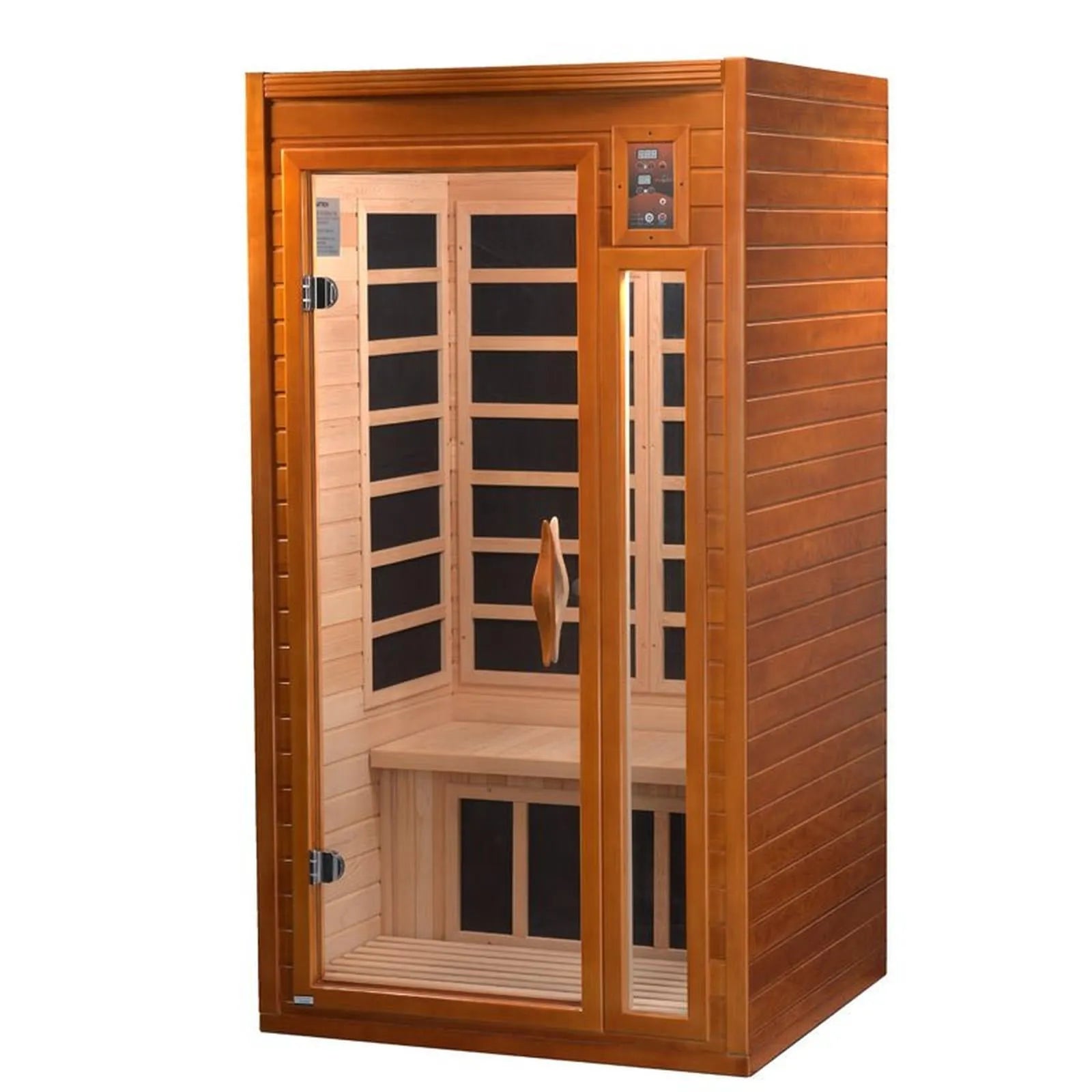
| Dynamic Avila (DYN-6103-01) | 7 carbon heaters | Low EMF | 120V / 15A dedicated |
| Barcelona Elite (DYN-6106-01) | 6 carbon heaters | Ultra-Low EMF | 120V / 15A dedicated |
| Cardoba Elite (DYN-6203-01) | 7 carbon heaters | Ultra-Low EMF | 120V / 15A dedicated |
| Gracia Full Spectrum (DYN-6119-03-FS) | Full spectrum — carbon plus NIR element | Near Zero EMF | 120V / 15A dedicated |
Two patterns are worth naming. First, heater count is not a quality ranking — a six-panel cabin and a seven-panel cabin in this lineup differ in interior geometry, not in capability. Second, all of these run on a standard dedicated 120V/15A circuit, which is unusual among high-draw wellness equipment and a genuine practical advantage. What "dedicated" means in practice is covered in our home sauna electrical guide.
How to choose, in order
- Decide whether you want near-infrared at all. If you do, you are buying a full-spectrum cabin and accepting a second emitter type with different EMF characteristics. If you don't, a carbon far-infrared cabin is simpler, cheaper and more consistent.
- If EMF is your priority, choose the tier, not the marketing phrase. Ultra-Low EMF carbon panels are the manufacturer's lowest published figure at under 3 mG.
- Ignore heater count as a headline. Match cabin size and seating layout to your space and body first.
- Confirm the circuit before you buy, not after delivery. A dedicated circuit is a real electrical requirement, not a recommendation.
- Then choose the wood. It affects durability, smell and price rather than heat delivery — see our hemlock versus western red cedar comparison.
Frequently asked questions
Are carbon heaters better than ceramic heaters?
They are different, not strictly better. Carbon panels spread output over a large, cooler surface, which produces more even far-infrared coverage and lower surface temperatures. Ceramic elements run hotter over a smaller area, which concentrates intensity. For a residential cabin where people sit close to the walls for extended periods, the even coverage of carbon is the reason it dominates the category.
Does full spectrum mean more powerful?
No. It means the cabin includes an additional near-infrared emitter alongside its far-infrared panels, covering near, mid and far infrared rather than far infrared alone. It is a broader range of wavelengths, not a higher intensity of the same one.
Do full-spectrum saunas have higher EMF?
The near-infrared element does. Golden Designs publishes its Ultra Low EMF carbon panels at under 3 mG at approximately two inches, and its Low EMF NIR elements at about 5–10 mG at the same distance. The carbon panels in a full-spectrum cabin are unchanged; the added NIR emitter is the higher-field component.
How long does a carbon infrared sauna take to warm up?
Longer than a small, high-temperature element, because large low-temperature emitters reach steady output more slowly. For scale, Ceramicx publishes roughly 10 to 12 minutes to steady-state for its ceramic elements. Cabin warm-up is a different measurement again — it depends on room temperature, cabin volume and target setting — so treat the manufacturer's preheat guidance for your specific model as the reference rather than any general figure.
How many heaters should a sauna have?
Heater count follows cabin geometry, not quality. Among the two-person cabins in this range, six- and seven-panel configurations sit at the same price and specification tier. Choose on interior dimensions, EMF tier and wood instead.
Can I add near-infrared to a far-infrared sauna later?
Treat this as a manufacturer question for your specific model rather than a general yes. Adding or substituting components is the kind of modification that voids coverage under Golden Designs' factory warranty, so confirm in writing before altering a cabin. Our guide to what infrared sauna ownership actually requires covers which actions forfeit warranty protection.
Is there a published wavelength figure for these sauna heaters?
Not per model. Manufacturers in this category publish emitter type and EMF measurements, not peak-wavelength figures for individual cabins. The micron ranges in this article describe emitter classes in industrial infrared heating, which is where that physics is actually documented.
Where to go next
If you are choosing between formats rather than emitters, the home sauna buyer's guide compares infrared, traditional and hybrid cabins, and the ownership and maintenance guide covers what a cabin asks of you after delivery.
To compare hardware directly, browse the full sauna collection, the far-infrared carbon-panel cabins, the full-spectrum range, or the low, ultra-low and near-zero EMF options.
Still deciding between a carbon cabin and a full-spectrum one? Our team can walk through the EMF figures, the circuit requirement and the layout for your room before you commit.