

Cold Plunge Electrical Requirements: GFCI, Circuits and Safe Installation
Short answer: a cold plunge puts a person in water and an electrical appliance beside them, which is the exact scenario ground-fault protection exists for. Plan on GFCI protection, a dedicated circuit, a weather-rated receptacle if it's outside, and no extension cord — and have a licensed electrician confirm the installation against your local code. A standard circuit breaker will not protect you here; it is designed to protect the wiring, not the person.
Cold plunge listings tend to say very little about power. Some publish a voltage and stop. Some say "standard outlet" and leave the rest to you. Meanwhile the installation itself — several hundred litres of water, a refrigeration compressor, a circulation pump, and often a garage floor or a patio — is one of the more demanding electrical environments in a home.
This guide covers what the equipment actually asks for, why ground-fault protection is the non-negotiable part, and the questions to settle before delivery day rather than after.
Scope, stated plainly. This is a planning guide, not wiring instructions. Circuit work is licensed trade work in most jurisdictions, electrical codes are adopted and amended locally, and the authority having jurisdiction has the final say. Everything below is intended to help you brief an electrician properly and read a specification sheet critically — not to help you do the work yourself.
Why a normal breaker is not the protection you need
This is the single most common misunderstanding, and it matters more here than almost anywhere else in the house.
| Device | What it protects | What trips it |
|---|---|---|
| Standard circuit breaker | The wiring — from overload and short circuit | Tens of amps of excess current |
| Ground-fault circuit interrupter (GFCI) | The person — from current leaking to ground | A tiny imbalance, around 5 milliamperes |
The difference is roughly three orders of magnitude. A 15-amp breaker will sit there perfectly happily while a fault current far below its threshold passes through a person. That gap is precisely what ground-fault protection closes.
OSHA describes the mechanism directly. A ground fault "occurs when there is a break in the low-resistance grounding path from a tool or electrical system," and when that happens "the electrical current may then take an alternative path to the ground through the user, resulting in serious injuries or death." The GFCI is "a fast-acting circuit breaker designed to shut off electric power in the event of a ground-fault within as little as 1/40 of a second," working by comparing "the amount of current going to and returning from equipment along the circuit conductors" — and when those differ "by approximately 5 milliamperes, the GFCI interrupts the current."
Standing in water does two things at once: it lowers your body's resistance and it gives fault current an excellent path to earth. Both make the scenario OSHA describes more likely and more consequential.
Where the GFCI actually lives
Ground-fault protection can sit in three different places, and knowing which one you have matters when something trips.
- Built into the appliance cord. Many plug-in chillers ship with an in-line GFCI module on the lead. This protects the appliance's own cord and load.
- In the receptacle. A GFCI outlet protects whatever is plugged into it, and often downstream outlets on the same circuit.
- In the breaker. A GFCI breaker at the panel protects the entire circuit, including the cable run itself.
An appliance with built-in protection is not automatically a reason to skip protection at the circuit — particularly outdoors, where the receptacle and the run to it are also exposed. That is a decision for your electrician against your local code, not a preference.
What the equipment in this category actually specifies
Here is what the manufacturers publish, quoted as published.
| Unit | Published electrical requirement | What's missing |
|---|---|---|
| Dynamic Premier 1.0 HP | "Standard 120V outlet with built-in GFCI safety protection" | No amperage, no wattage, no circuit rating |
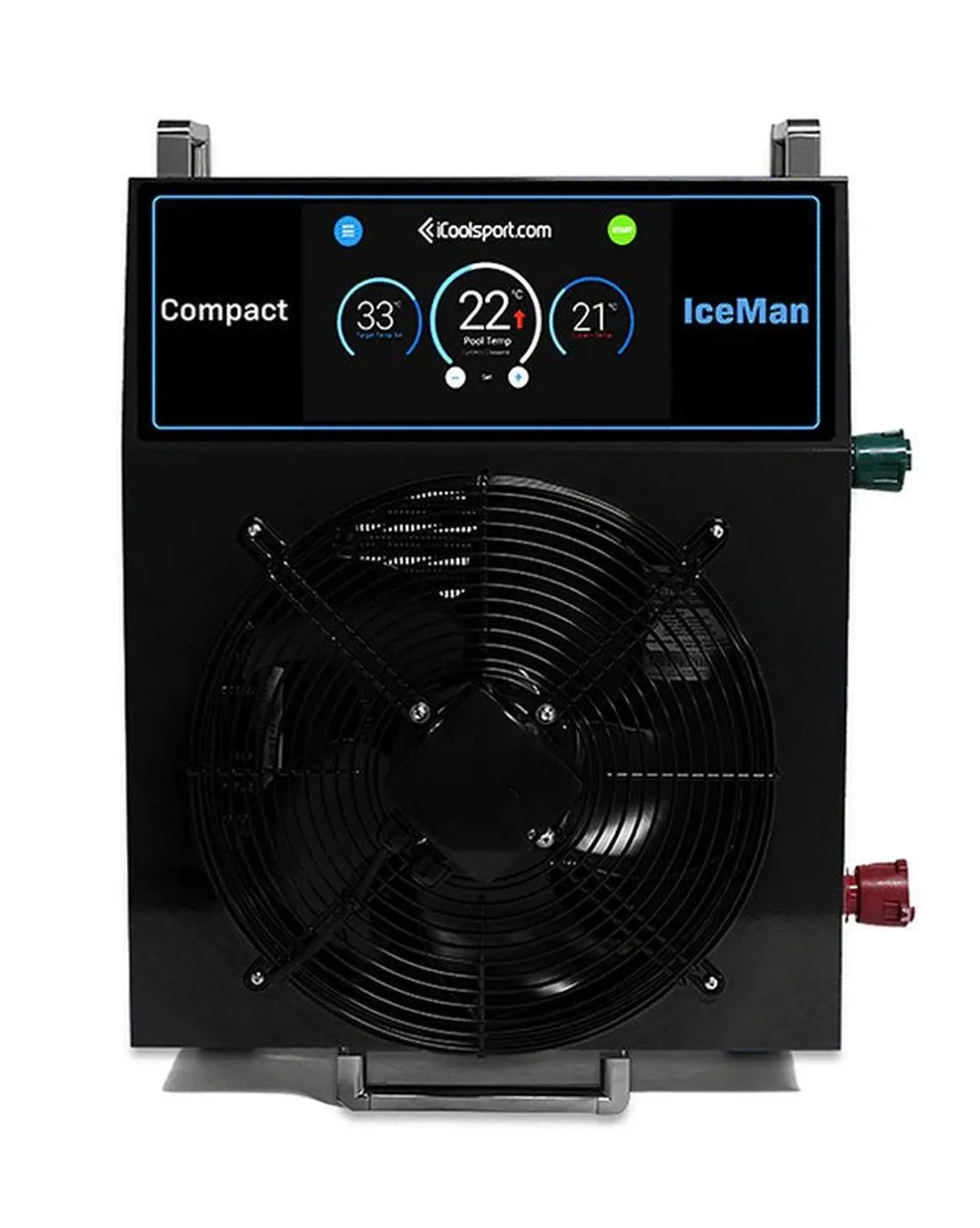
| iCool Iceman | "Voltage: 110V or 220V Dedicated Models" | No amperage, no GFCI/RCD statement in the listing |
Notice what is absent. Both publish voltage. Neither publishes running amperage or starting current, which are the numbers an electrician actually needs to size a circuit. This is normal for the category and it is not a reason for alarm — it is a reason to ask for the nameplate rating before you book the electrician, so the circuit gets sized against the real figure rather than an assumption.
Note also that the Iceman is offered in "110V or 220V Dedicated Models." Voltage is a purchase decision on that unit, not a field adjustment. Choosing the wrong one is an expensive mistake to discover on delivery day.
Why a dedicated circuit is worth insisting on
A dedicated circuit serves one appliance and nothing else. For a cold plunge, it earns its cost in three ways:
- Compressor starting current. Refrigeration compressors draw a surge at start-up that is substantially higher than their running draw. Sharing a circuit with other loads makes nuisance tripping likely.
- Diagnosis becomes possible. When a dedicated circuit trips, you know what caused it. When a shared circuit trips, you are guessing between the plunge, the freezer and the power tools.
- Continuous duty. A chiller holding temperature cycles on and off around the clock. That is a very different load profile from an appliance used for twenty minutes a day.
Saunas in this category work the same way — the infrared cabins are specified for a dedicated 120V/15A circuit. If you are planning a room that contains both, they are two separate circuits, not one shared one. Our home sauna electrical guide covers the cabin side in detail.
Extension cords, and why manufacturers keep saying no
The temptation is obvious: the tub is eight feet from the nearest outlet. The reasons not to are worth stating properly.
- Voltage drop over a long or undersized cord makes a compressor draw more current, run hotter and work harder.
- Cord-to-plug connections are the weak point, and outdoors they sit in exactly the wet, dirty, walked-on conditions that degrade them.
- Using one commonly falls outside the manufacturer's installation instructions, which can bear on warranty coverage.
The correct fix is a properly located receptacle, installed by an electrician. It costs more than a cord and it is the difference between a permanent installation and a temporary one.
Outdoor and garage installations
Most cold plunges do not live in a finished indoor room, which puts them in the more demanding half of the code.
- Weather-resistant receptacles with in-use covers. An outdoor outlet needs a cover that keeps water out while a plug is in it, not only when it is empty.
- Ground-fault protection is more critical, not less. Wet ground, bare feet and standing water all worsen the fault path.
- Drainage and siting matter electrically. Where water goes when you drain or splash determines what gets wet repeatedly. Our setup guide for garage, backyard and indoor installations covers placement and drainage.
- Ambient heat is an electrical issue too. A chiller working harder in a hot garage draws more and runs longer, which is part of why sizing and circuit planning belong in the same conversation — see our chiller sizing guide.
Living with it: testing and trips
GFCI devices are electromechanical and they do not last forever. They have a test button because testing them is part of ownership, and a common recommendation is to test monthly.
Treat a repeated trip as information, not an inconvenience. A GFCI that keeps tripping is either detecting a real leakage path or failing — and both need an electrician. The one response that is never appropriate is bypassing the protection, plugging into a non-protected outlet, or defeating the device to "see if it holds." If it trips repeatedly, stop using the unit until someone qualified has looked at it.
The checklist to hand your electrician
- Manufacturer's nameplate: voltage, running amps, starting current, and the model's stated circuit requirement.
- Whether the unit ships with in-line GFCI protection, and whether additional protection is required at the receptacle or breaker under your local code.
- Dedicated circuit, sized to the nameplate rather than to a guess.
- Receptacle location, and outdoor rating with an in-use cover where applicable.
- The installation environment: indoor, garage or exterior; ambient temperature range; drainage.
- Any second appliance sharing the space — a sauna needs its own dedicated circuit.
- Local code edition and whether a permit or inspection applies.
Frequently asked questions
Does a cold plunge need a GFCI?
Ground-fault protection is the appropriate safeguard for an electrical appliance used with a person immersed in water, and equipment in this category is commonly supplied with it built in — the Dynamic Premier chiller, for example, publishes "standard 120V outlet with built-in GFCI safety protection." Whether additional protection is required at the receptacle or the breaker depends on your local code and installation, which is a question for a licensed electrician and your local authority.
Can I plug a cold plunge chiller into a regular outlet?
Many are designed for a standard 120V supply, but "standard outlet" and "correctly protected dedicated circuit" are not the same claim. Check the nameplate, confirm ground-fault protection, and give a continuously cycling compressor its own circuit rather than sharing with other loads.
What is the difference between a GFCI and a circuit breaker?
A circuit breaker protects the wiring from overload and short circuit, tripping at tens of amps. A GFCI protects people, interrupting the circuit when current going and returning differ by about 5 milliamperes — roughly a thousand times smaller. A breaker alone will not protect a person from a ground fault.
Can I use an extension cord with a cold plunge?
It is not the right solution. Voltage drop increases compressor current, cord connections are the failure point in wet outdoor conditions, and it commonly falls outside the manufacturer's installation instructions, which can affect warranty coverage. Have a receptacle installed where the equipment actually sits.
Why does my cold plunge keep tripping the GFCI?
A repeated trip means the device is detecting a leakage path, or the device itself is failing. Both require a licensed electrician. Do not bypass the protection, move to an unprotected outlet, or keep resetting it — stop using the unit until it has been inspected.
Does a 220V cold plunge chiller need different wiring?
Yes, and it is a purchase decision rather than a field change on units offered in separate voltage models — the iCool Iceman is sold as "110V or 220V Dedicated Models." Confirm which one you are ordering before the electrician designs the circuit.
Do I need a permit to install a cold plunge circuit?
That depends entirely on your jurisdiction, and it is decided locally rather than by the manufacturer. Adding a circuit commonly requires a permit and inspection. Your electrician will know the local requirement; ask before work starts.
Where to go next
Plan the capacity alongside the circuit — our chiller sizing guide explains how volume, target temperature and ambient conditions determine what you need, and the 2026 chiller comparison covers specific units.
Before your first session, please read cold plunge safety and heart health. Cold immersion is not suitable for everyone, and that is a conversation for you and your clinician.
To browse hardware, see the cold plunge chillers, the cold plunge tubs, or the full cold therapy range. Tell our team where the tub will live and we can tell you exactly what to put in front of your electrician.