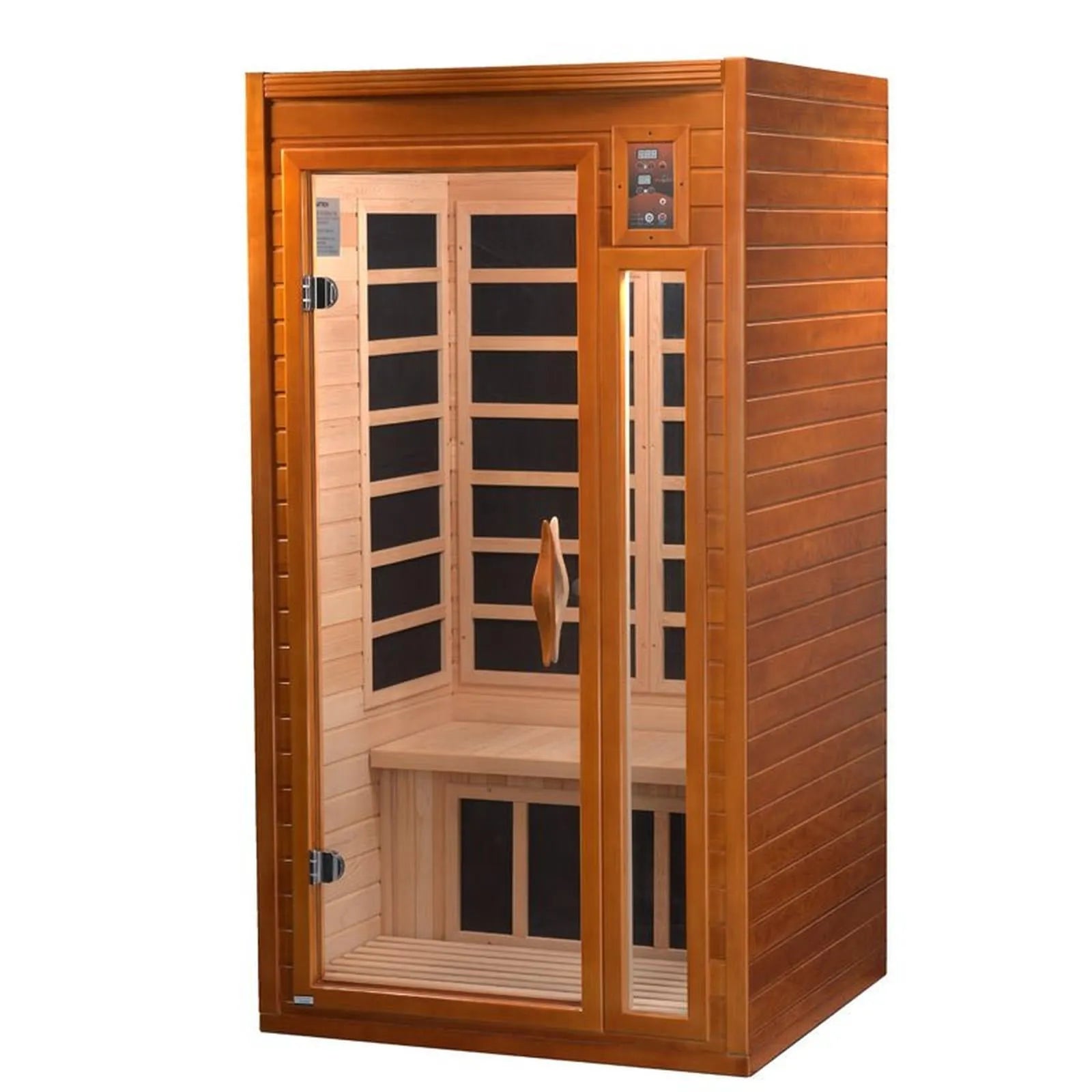

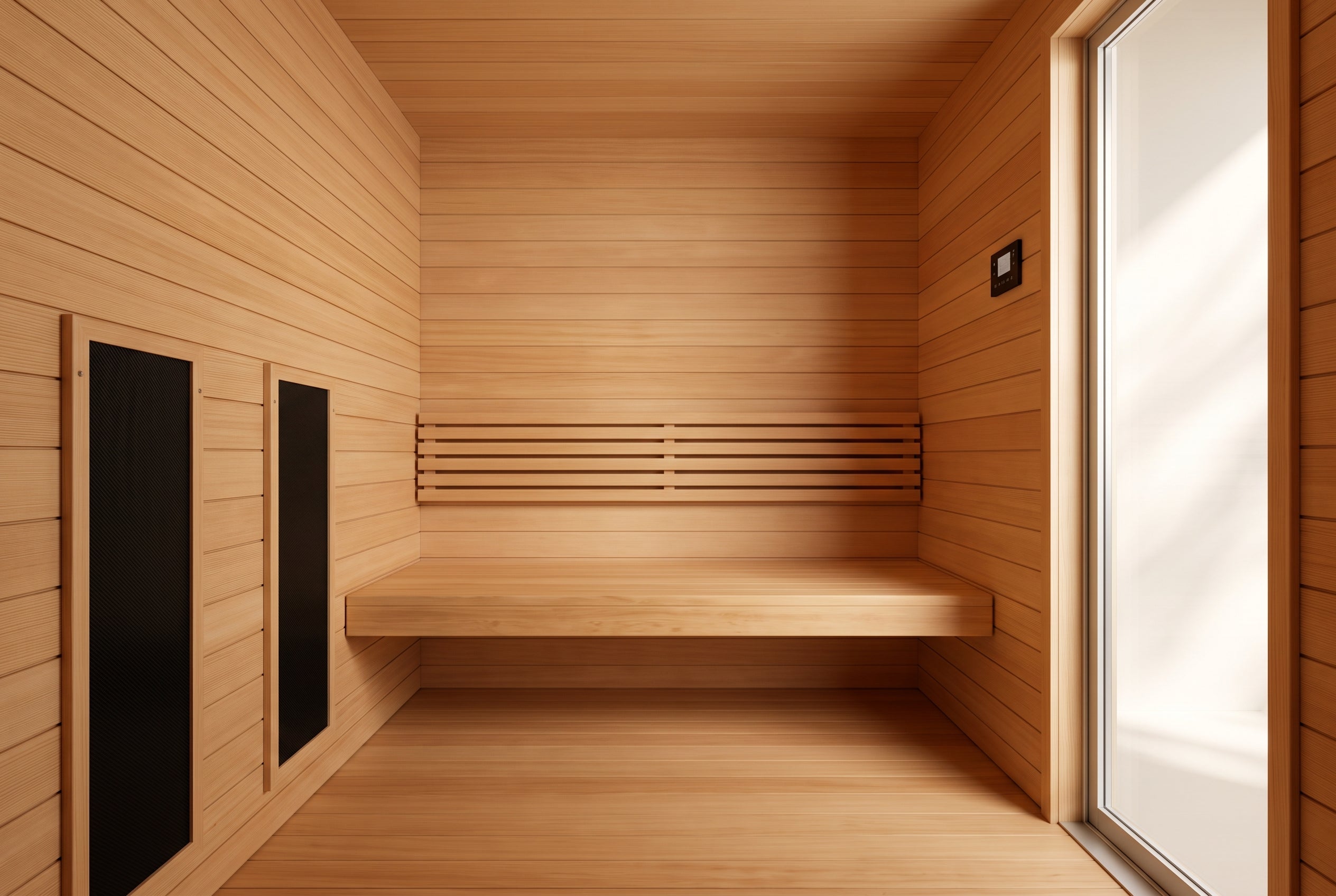
Infrared Sauna Maintenance and Care: What Ownership Actually Requires
Short answer: an infrared sauna needs far less upkeep than a traditional steam room, because nothing in it gets wet by design. Budget about five minutes after each session, twenty minutes a month, and one careful inspection a year. The habit that protects the cabin most is the simplest: sit on a towel, and wipe the bench dry afterwards.
Most infrared sauna owners are told their cabin is "virtually maintenance free." That is close enough to true that it becomes a problem, because it sets the expectation that there is nothing to do at all. Then a bench gets scrubbed with a household spray, a cabin gets moved onto a covered patio for the summer, or a small electrical fault gets ignored for a season — and the owner discovers the limits of their coverage at the worst possible moment.
This guide covers what infrared sauna ownership actually asks of you: the routine, the wood, the glass, the heaters, and the specific decisions that determine whether a manufacturer will stand behind the cabin in year three. It is written for people who already own a cabin and for people working out what ownership costs in time before they buy one.
What actually needs doing, and how often
Infrared cabins don't use rocks, water, or steam, so there is no scale, no drainage, and no standing humidity to manage. What accumulates instead is sweat residue, body oils, dust and hair — mostly on benches, backrests and the floor.
| Interval | Task | Why it matters |
|---|---|---|
| Every session | Sit on a towel; keep a second towel for wiping perspiration | Keeps sweat out of the timber in the first place. This is the highest-value habit in the whole routine |
| After each session | Wipe benches and backrests dry; air the cabin before closing it up | Sweat residue is what actually stains sauna wood |
| Weekly | Vacuum or sweep the floor, including around the floor heater | Hair and dust collect at floor level, where the lowest heater sits |
| Monthly | Wipe the glass; visually inspect heater faces, cords and the control panel | Electrical faults are cheaper and easier to address early |
| Annually | Check bench fasteners, door alignment and glass seals | Cabinets settle. A door that no longer seats squarely wastes heat every session |
Towels do most of the work
Golden Designs' own sauna use guide is direct about this: "Take at least two towels inside the sauna with you, one to sit on and the other to wipe away perspiration."
Read as maintenance advice rather than comfort advice, that single instruction prevents most of the wear owners later complain about. Sweat is mildly acidic and carries body oils and skin products with it. Absorbed repeatedly into unfinished timber, it is what produces darkened patches on bench tops and the faint stale smell that some cabins develop after a year or two.
A towel on the bench, a towel underfoot, and a quick wipe-down afterwards costs nothing and removes the problem at source.
Cleaning the wood: less product, not more
The most common ownership mistake is treating sauna wood like furniture. It is not finished like furniture, and it should not be sealed, varnished, oiled or waxed. Coatings trap residue at the surface and behave unpredictably under repeated heat cycling.
For routine cleaning, a dry or barely damp cloth handles almost everything. Let the cabin cool first — never clean a hot cabin, and never apply liquid near a heater face or an electrical fitting.
Check your own manual before using any product. Golden Designs Inc — the manufacturer behind the Golden Designs, Dynamic and Maxxus cabins in this category — does not publish cleaning instructions on its public FAQ or its use guide. Cleaning guidance is model-specific and lives in the owner's manual that shipped with your cabin. If you no longer have it, ask your retailer or the manufacturer for the manual matching your model number rather than guessing. Infrared cabin manuals typically restrict cleaning to a narrow set of methods and prohibit solvents and aerosols.
If a bench develops a mark that wiping won't lift, light sanding with fine-grit paper along the grain is the conventional remedy for unfinished sauna timber, because it removes the affected surface rather than coating it. Confirm it is acceptable for your model first, and never sand near a heater face.
Glass, floors and mats
Glass
Sauna glass shows every fingerprint and every drip. Clean it cool, with a soft cloth, and spray any cleaner onto the cloth rather than onto the glass — overspray running down onto timber or into a door seal is the thing to avoid. Keep cleaner off the wooden frame and away from hinges.
Floors
The floor collects hair, dust and whatever comes off feet, and it usually houses the lowest heater. Vacuum it weekly and keep the area around the floor heater clear.
Mats and towels underfoot
A washable mat or towel on the floor is worth using and worth washing regularly. Avoid rubber-backed mats that sit permanently in place; anything that traps moisture against timber works against you. Take mats out to dry rather than leaving them in a closed cabin.
Odours, stains and discolouration
Three different problems get confused with one another, and they have different answers.
- A stale or sour smell is almost always absorbed perspiration, concentrated in bench tops and backrests. Towel use prevents it; airing the cabin properly after sessions keeps it from settling in.
- Darkened patches in high-contact areas are sweat staining in the surface of the timber. This is cosmetic, and light sanding along the grain is the usual remedy for unfinished wood — confirmed against your manual first.
- Even, gradual colour change across the whole interior is not a fault at all. Wood darkens with heat and light over time. It is not damage and it is not reversible.
What no infrared cabin should ever smell of is burning, hot plastic or anything sharp and electrical. That is a stop-and-inspect signal, covered below.
Moisture and mould prevention
Infrared cabins don't generate steam, but the people inside them sweat, and a sealed box holding humid air is how problems start. Three habits cover it:
- Air the cabin after every session. The manufacturer's guidance is to turn the power off and sit with the door open slightly for five to ten minutes as your body cools. Leaving the door ajar a while longer after you get out lets residual moisture leave rather than sit in the grain.
- Dry what is wet. Wipe benches, take towels and mats out, and don't store damp items inside the cabin.
- Think about the room, not just the cabin. An unventilated basement corner stays damp regardless of what the sauna does. If the room already has a humidity problem, the sauna will sit inside it.
Cabins also need clearance behind and beside them for airflow and for service access to the electrical connections. The manufacturer confirms the cabin can sit on "virtually any common flooring surfaces from concrete and tiled flooring to wood and carpeted flooring" — carpet is permitted, but it is harder to keep clean underneath and traps what falls through the door.
What's normal in the wood — and what isn't
Hemlock and cedar both move. They expand and contract with heat cycling, and fine surface cracks appear in nearly every cabin eventually.
Golden Designs' warranty terms state directly that "surface cracks are not considered defects," treating them as normal wood behaviour rather than a fault. That is not a brush-off; it is how solid timber responds to repeated heating.
What is not normal, and is worth reporting promptly:
- A crack passing through a load-bearing bench support rather than sitting on the surface
- Panels separating at the joints so the cabin no longer seals
- Warping severe enough that the door won't close flush
- Any scorching, discolouration or heat smell around a heater face or cable
If you're still choosing a cabin, our comparison of Canadian hemlock and western red cedar covers how the two timbers differ in practice.
Heaters and electronics: where the coverage actually sits

The most valuable part of an infrared sauna warranty is the part owners never read. Golden Designs' factory warranty covers heating elements and electronics for five years in residential use, while wood and structure carry a one-year limited warranty. The expensive electrical components are protected considerably longer than the cabinet around them.
Two consequences follow. First, protect the cabinetry, because its coverage window is short — scratches, stains and impact damage are on you after twelve months. Second, don't tolerate electrical symptoms: a heater that no longer warms, a control panel behaving erratically, a flickering chromotherapy light. Those are the components with years of coverage remaining, and reporting them early costs nothing.
Heater care itself is almost entirely passive. Keep the panel faces clear and unobstructed, don't hang towels over them, don't lean anything against them, and dust them only when the cabin is cool and only with a dry cloth. No liquid, ever.
Commercial buyers, read this line carefully. The same warranty drops heating elements and electronics to one year for commercial use. If you're specifying a cabin for a gym, studio, clinic or recovery facility, coverage is a fifth of the residential term. That should shape both the model you choose and the service arrangement you put alongside it.
Cords, plugs and circuits: what to check, what not to touch
There is a clear line here, and it is worth respecting.
Check visually, monthly: that the plug is fully seated, that the cord isn't pinched behind the cabin or run under a rug, that there is no discolouration or melting at the plug or outlet, and that nothing feels hot to the touch at the connection.
Do not do yourself: open the control housing, repair or splice a cord, replace a heater, rewire a plug, or bypass a breaker. Beyond the obvious safety issue, modifications to the cabin or its components void the warranty outright.
A breaker that trips repeatedly when the sauna runs is a circuit message, not a sauna quirk — and it needs an electrician rather than a workaround. Our home sauna electrical guide covers what these cabins draw and how circuits should be specified.
Five things that void the warranty
These come directly from the manufacturer's published terms, and every one is avoidable.
- Putting an indoor cabin outdoors. The warranty states that "placement outdoors will VOID this warranty," including damage from rain, snow, sun and wind. A covered porch or open garage still counts as outdoors.
- Modifying the sauna. Modifications to the cabin or its components void coverage — including well-intentioned ones like adding your own lighting or swapping a speaker.
- Assuming it transfers with the house. Coverage extends "to the original purchaser at the original site of installation only" and is not transferable.
- Treating wear as a defect. Normal wear and tear is excluded, as are the surface cracks described above.
- Skipping registration. Golden Designs runs a warranty registration process. Registering at purchase, while the model number and receipt are to hand, avoids an argument later.
Why your manual governs, not this article
Requirements genuinely differ between cabins, and a rule that fits one model can be wrong for another. Within this manufacturer's own range you will find hemlock and red cedar interiors, carbon and full-spectrum emitters, plug-in 120V cabins alongside 20-amp and 240V units, and models with extras — chromotherapy lighting, salt bars, LCD panels, audio — that each carry their own care notes.
Indoor infrared cabins and outdoor hybrids are covered by entirely separate warranties. Treat anything in this guide as the general shape of ownership, and treat your model's manual as the authority.
Outdoor and hybrid cabins follow different rules
Everything above describes indoor infrared cabins. Hybrid and outdoor saunas — all-weather units combining full-spectrum infrared with a traditional stove — are built for exposure and covered under a separate warranty.
They also carry genuinely different maintenance: exterior timber weathers and needs periodic attention, and the traditional stove side introduces water, rocks and steam that indoor infrared cabins simply don't have. If you're weighing an indoor cabin against something like the Loviisa outdoor hybrid, treat upkeep as a real line item rather than an afterthought.
When to stop using it and call for service
Turn the cabin off at the breaker and get it looked at if you notice any of the following:
- A burning, sharp or electrical smell during or after heating
- Visible scorching, melting or discolouration on or around a heater
- Damaged, pinched or exposed wiring
- A heater that stays cold while others heat normally
- A breaker that trips repeatedly when the sauna runs
The maintenance checklist
Every session
- Two towels — one to sit on, one to wipe with
- Wipe benches and backrest dry before leaving
- Power off, door ajar to air the cabin
- Take towels and mats out to dry
Weekly
- Vacuum or sweep the floor, including around the floor heater
- Wash mats and bench towels
Monthly
- Wipe glass with a cloth, cabin cool, cleaner on the cloth not the glass
- Visual check: heater faces clear, cord not pinched, plug seated, no discolouration at the outlet
- Confirm the control panel reads and responds correctly
Annually
- Check bench fasteners and door alignment
- Inspect glass seals and hinges
- Re-read the care section of your model's manual
What to ask before you buy
Maintenance is easier to judge before purchase than after. Worth asking:
- What exactly does the warranty cover, and for how long — separately for wood, heaters and electronics? The split matters more than the headline number.
- Is the warranty different for commercial use? For this manufacturer it is: five years drops to one.
- Is it transferable, and what happens if I move house?
- What does the manual actually say about cleaning? Ask to see the care section before you buy, not after.
- What are the electrical requirements — plug-in, 20-amp, or 240V hardwired? This decides whether an electrician is part of your purchase.
- Which extras add upkeep? Salt bars, chromotherapy lighting, audio and screens each add something to look after.
- How are replacement heaters and parts supplied, and by whom?
Frequently asked questions
How often should I clean an infrared sauna?
Wipe the benches dry after each session and vacuum the floor weekly. Deeper cleaning is needed far less often than most owners assume, because infrared cabins never get wet by design.
Can I use household cleaning spray inside my sauna?
Check your model's owner's manual first. Infrared cabin manuals typically restrict cleaning to specific methods and prohibit solvents and aerosols, and the wood is not finished the way furniture is. When in doubt, a dry or barely damp cloth on a cool cabin is the safe default.
Should I seal or oil the wood?
No. Sauna interiors are not intended to be sealed, varnished, oiled or waxed. Coatings behave unpredictably under repeated heat cycling.
How do I clean the glass?
Let the cabin cool, use a soft cloth, and apply any cleaner to the cloth rather than spraying the glass directly. That keeps overspray off the timber frame, the hinges and the door seal.
Why does my sauna smell stale?
Almost always absorbed perspiration in the benches. Sitting on a towel prevents it, and airing the cabin with the door ajar after each session stops moisture settling in. A burning or electrical smell is a different matter entirely — stop using the cabin and have it inspected.
Are cracks in the wood a defect?
Surface cracks are explicitly not treated as defects under Golden Designs' warranty — they are normal behaviour in solid timber heated and cooled repeatedly. Structural cracks through a bench support, joints separating, or a door that no longer closes flush are different, and worth reporting.
How long is an infrared sauna warranted?
Under Golden Designs' factory warranty, heating elements and electronics are covered for five years in residential use and one year in commercial use, while wood and structure carry a one-year limited warranty. Coverage applies to the original purchaser at the original installation site and is not transferable.
Can I put my indoor sauna in the garage or on a covered porch?
Not without losing your warranty. The manufacturer's terms state that outdoor placement voids coverage, including damage from rain, snow, sun and wind. If you want a cabin outside, buy one built and warranted for it.
Can I replace a heater myself?
No. Modifications to the cabin or its components void the warranty, and this is electrical work. Report a failed heater rather than opening anything up — in residential use it is likely still covered.
How long do the heaters last?
There is no published service-life figure for these carbon heater assemblies, so treat any specific number you see quoted with caution. What is documented is the coverage period: five years residential. A monthly visual check is the practical way to catch a failing element early.
Where to go next
If you're still deciding on a cabin, the home sauna buyer's guide walks through infrared, traditional and hybrid formats, and our low-EMF and ultra-low-EMF explainer covers a specification that is frequently misunderstood.
To see what's available, browse the full sauna collection, the infrared cabins, or the low, ultra-low and near-zero EMF range. Popular starting points include the two-person Dynamic San Marino in Canadian hemlock and the full-spectrum Maxxus red cedar cabin.
Not sure which suits your space or circuit? Our team can walk through placement, power and upkeep before you commit.