
Portable Hyperbaric Chambers: Weight, Packed Size, Setup and Power
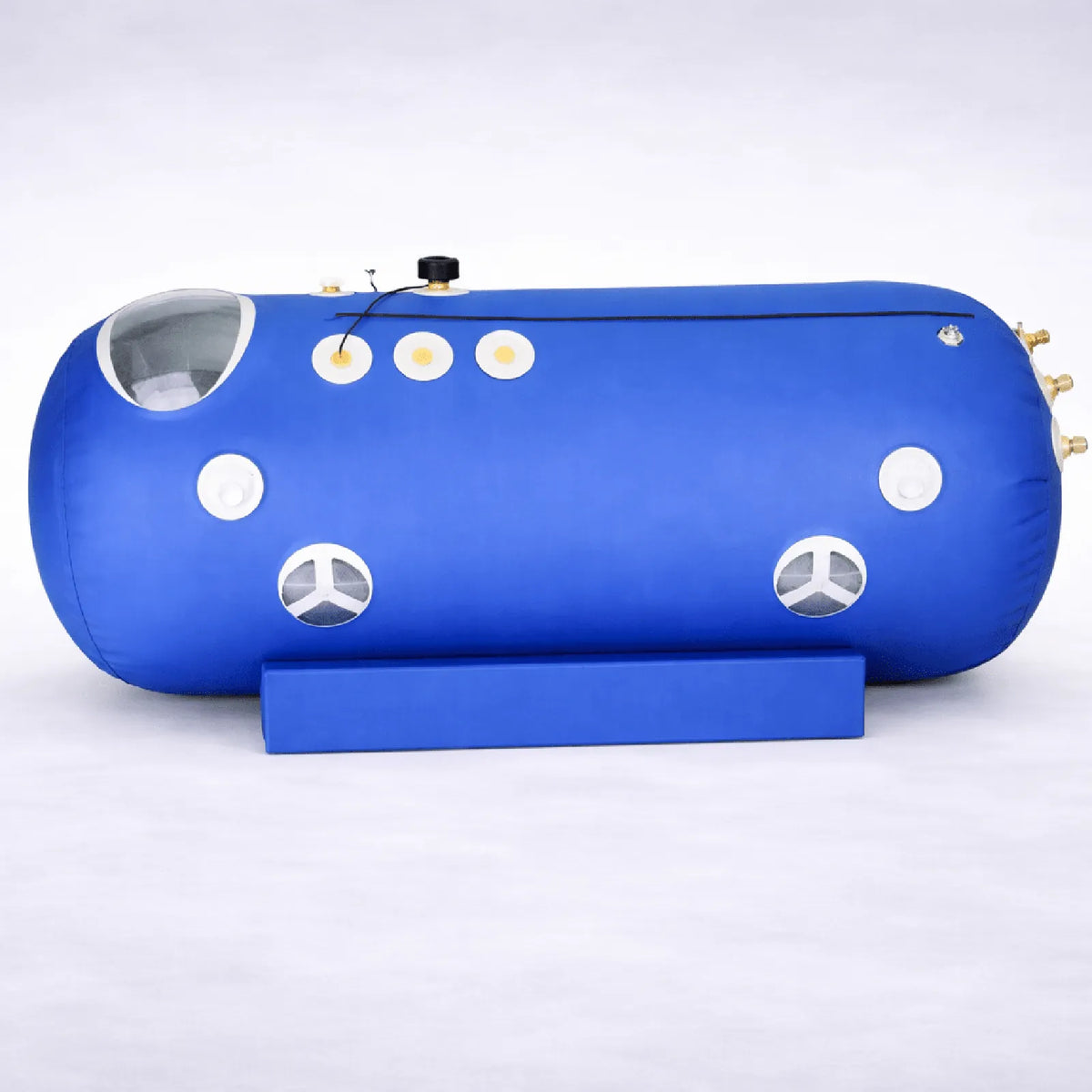
Short answer: a portable hyperbaric chamber is one designed to be deflated, packed and moved. It is not one you can carry in one hand. What you actually move is a system: the chamber, one or more compressors, usually an oxygen concentrator and an air cooler, plus a frame and mat. To judge how portable a model really is, add up the weight of every component, measure its inflated footprint with working room, and read the power requirement of the whole system. Compare models in our hyperbaric chamber collection.
What "portable" covers, and what it leaves out
Manufacturers use "portable" for chambers that pack down and run from an ordinary outlet. The word describes how the chamber is moved and stored. It says nothing about how long setup takes, whether you can get in and out alone, or how much floor the running system occupies. Those are the questions below.
Weight: read "chamber only" carefully
A listing may give one weight, and it may be for the chamber alone. The OxyCheny CY8 in our range is an example: its manufacturer lists 25 kg under the chamber, and lists the oxygen concentrator and air cooler as separate items. Their weights are not in that figure.
Ask for a weight for each component and for the packed shipment. Then ask the practical question: can one person lift the heaviest single item into a car or up a flight of stairs?
Packed size, frame and case
A chamber that packs down still has to be carried and kept somewhere. Check what the purchase includes. The Summit to Sea Dive in our range is listed with an external frame, a foam mat and a carrying case as part of the package, not as add-ons.
Ask the manufacturer for the packed dimensions, whether the frame folds or dismantles, and how the chamber should be stored between uses. Ask for the storage conditions in the manual.
Inflated footprint and working room
| Example in our range | Listed chamber size | What else needs floor |
|---|---|---|
| Summit to Sea Dive | 33 in diameter × 90 in long | Two compressors within reach of an outlet; clear access on the zipper side |
| OxyCheny CY8 | 850 mm diameter × 2100 mm long | Oxygen concentrator and air cooler |
The Dive figures are from Summit to Sea's documentation as reflected on our product page. The CY8 figures are from OxyCheny's CY8 specification. The chamber's own dimensions are the smallest number you will need. Add room to open the zipper and get in, and a spot for each machine with its hoses. Our room requirements and site planning guide shows how to lay a room out.
Setup: what to find out before the first use
Setup time is rarely published, so ask.
- How many people does first assembly take?
- Can the user enter, seal and exit without help? On the Summit to Sea Dive, the listing describes full-length zippers that operate from inside or outside the chamber. Ask the same of any model.
- What connects to what? Count the hoses and machines, and ask for the setup pages of the manual before you buy.
- What surface does it need? The Dive is specified for a level floor.
Power for the whole system
Several machines run at once, so read the electrical line for each.
- The Summit to Sea Dive is specified by its manufacturer for a standard 120V, 15A household outlet, with no dedicated or high-voltage supply called for. The listing advises positioning it so both compressors reach an outlet without an extension run.
- OxyCheny lists the CY8's oxygen concentrator at 110V 60Hz or 220V 50Hz and approximately 850 W, and its air cooler at 220V 50Hz and 250 W. Before ordering, confirm which voltage each machine supplied to you runs on.
Ask for the combined draw of everything that runs during a session and whether one circuit is enough. If you are unsure about the outlet you plan to use, a licensed electrician can check it against the electrical code adopted where you live, in the United States NFPA 70, the National Electrical Code. Our guide to oxygen concentrator requirements covers that machine on its own.
Moving and storing it
- Follow the manual's order for shutting down, deflating and disconnecting.
- Pack the chamber as the manufacturer shows; zippers, windows and valves are the parts to protect.
- Move each machine as its manual instructs.
- After a move, repeat the manufacturer's pre-use checks before the next session.
Documentation to ask for
Ask the manufacturer which standards the chamber is built and tested to, and for the documents that show it. The recognised engineering standard for these vessels is ASME PVHO-1, Safety Standard for Pressure Vessels for Human Occupancy. Whether a given model is built to it is a question for its manufacturer.
Frequently asked questions
How heavy is a portable hyperbaric chamber?
It varies by model, and the listed figure is often for the chamber alone. As one example, OxyCheny lists the CY8 chamber at 25 kg, with its machines listed separately. Ask for the weight of each component.
Does a portable hyperbaric chamber plug into a normal outlet?
Some are specified for a standard household outlet. Check the manufacturer's electrical requirement for the chamber and for every machine that runs with it.
Can one person set up a portable chamber?
Ask the manufacturer. It depends on the frame, the weight of the components and the zipper design.
Can a portable chamber be stored when not in use?
That is what the format is for, but follow the manual's instructions for deflating, packing and storage conditions.