

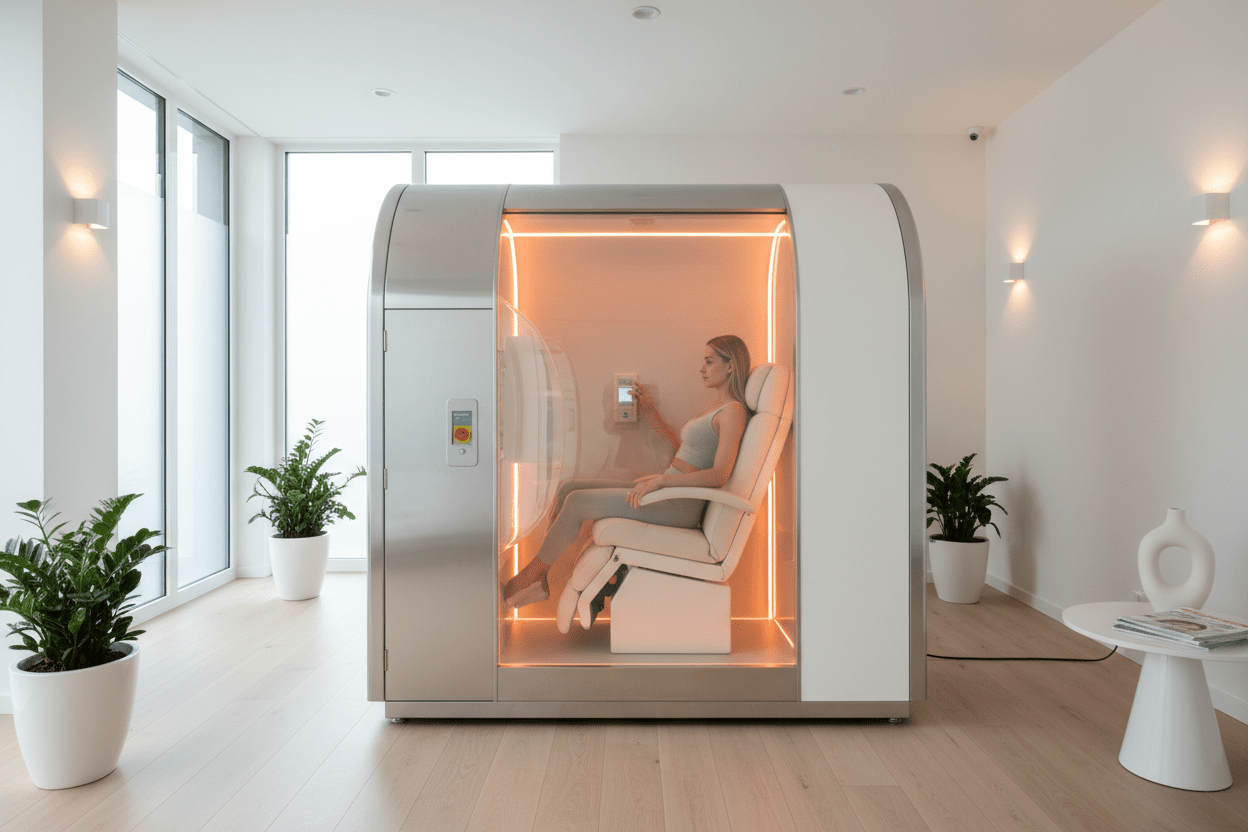
Hyperbaric Oxygen Therapy and Neurofeedback: What the Evidence Says About Combining Them
Hyperbaric oxygen therapy and EEG neurofeedback are both being explored in brain-recovery, cognitive-performance, and neurorehabilitation settings. But the claim that HBOT “fuels” neurofeedback—or that combining the two is a proven gold-standard protocol—goes beyond the available evidence. This guide separates established science from emerging theory and explains mechanisms, traumatic brain injury research, qEEG, safety, sequencing, clinic planning, and equipment questions.
Reviewed and updated: July 17, 2026 | Reading time: Approximately 18 minutes
Quick Answer
HBOT and neurofeedback have separate research literatures, but rigorous clinical evidence proving that the combination is superior to either therapy alone is currently limited.
HBOT can substantially increase dissolved oxygen under medically controlled conditions and is an established treatment for specific indications. Neurologic and cognitive uses—including chronic traumatic brain injury—remain investigational or condition-dependent.
EEG neurofeedback is a form of biofeedback that trains responses to real-time brain-activity signals. It has shown promise in selected studies, but outcomes vary by condition, protocol, clinician expertise, control group, and study quality.
HBOT, EEG, qEEG, and Neurofeedback: Essential Definitions
Hyperbaric Oxygen Therapy
Clinical hyperbaric oxygen therapy involves breathing medical oxygen inside a chamber pressurized above normal atmospheric pressure. Higher ambient pressure increases the amount of oxygen dissolved in plasma and other body fluids. HBOT is used in medically recognized settings for specific conditions under trained supervision.
Electroencephalography
EEG records electrical activity from electrodes placed on the scalp. It does not directly measure oxygen delivery, ATP production, inflammation, or individual-neuron health.
Quantitative EEG
qEEG applies mathematical analysis to EEG recordings and may compare features such as power, frequency distribution, asymmetry, or connectivity. Results require qualified interpretation and must be considered alongside symptoms, history, examination, and validated testing.
EEG Neurofeedback
Neurofeedback presents real-time or near-real-time information derived from brain activity. Visual, auditory, or game-like feedback is used to reinforce a target pattern.
These Are Different Tools
HBOT changes the pressure and oxygen environment. EEG measures electrical activity. qEEG analyzes EEG data. Neurofeedback uses measured activity to provide a training signal.
Why the “Brain Fuel” Metaphor Is Incomplete
The original article compared neurofeedback without HBOT to accelerating a car with an empty fuel tank. It is an appealing metaphor, but it overstates what can be concluded clinically.
A person with persistent symptoms after concussion, stress, pain, or trauma cannot automatically be described as oxygen-deprived or “metabolically bankrupt.” Symptoms can involve sleep, autonomic regulation, headache, vision and vestibular problems, medication effects, mood, pain, endocrine changes, deconditioning, and cognitive load.
HBOT does not selectively deliver oxygen only to qEEG-defined regions, and qEEG does not identify exactly where oxygen is “needed.” A more accurate statement is that HBOT may alter the biologic environment in ways being studied for neurorecovery, while neurofeedback may help selected people practice regulation of measurable brain-activity patterns.
How Hyperbaric Oxygen Changes Oxygen Delivery
At normal atmospheric pressure, most oxygen is carried by hemoglobin. During properly administered HBOT, higher pressure and elevated oxygen concentration increase dissolved oxygen in plasma. Research has also explored effects involving inflammatory signaling, edema, blood-vessel growth, mitochondrial function, and neuroplasticity.
BDNF, Stem Cells, and Neuroplasticity
Some HBOT studies have measured BDNF or other growth-related markers. However, it is not accurate to state that every session “floods the brain with BDNF” or creates new neurons predictably. Biomarker changes and meaningful functional outcomes are not the same endpoint.
| Claim | Evidence-Based Interpretation |
|---|---|
| HBOT sends oxygen past blocked circulation | Higher pressure increases dissolved oxygen, but tissue delivery and clinical benefit depend on the condition and protocol. |
| HBOT revives dormant neurons | This is a research-oriented metaphor, not a guaranteed clinical outcome. |
| HBOT causes BDNF proliferation | Some studies report changes in neurotrophic factors; results are not universal. |
| HBOT opens a neuroplasticity window | This is a plausible concept, not a precisely validated window for neurofeedback. |
How Neurofeedback Works—and Why Results Vary
Neurofeedback protocols differ considerably. Some train frequency-band amplitude at a small number of scalp sites. Others use coherence, infra-low-frequency activity, z-score systems, source-localized measures, or decoded brain states.
Quality depends on a clear goal, appropriate assessment, signal quality, artifact control, a defensible protocol, qualified interpretation, consistent delivery, adverse-response monitoring, and objective outcome measures.
Research includes encouraging studies, small trials, case reports, heterogeneous protocols, and trials that have not shown superiority over sham or comparison interventions. Possible adverse responses include headache, fatigue, agitation, sleep disturbance, emotional changes, dizziness, or temporary symptom worsening.
What Evidence Supports Combining HBOT and Neurofeedback?
Direct, high-quality evidence for a standardized HBOT-plus-neurofeedback protocol is sparse. The literature is stronger for studying each intervention separately than for demonstrating a unique synergy.
- HBOT has not been proven to make neurofeedback work faster.
- Oxygen has not been shown to prevent neurofeedback fatigue.
- HBOT has not been proven to “clean” qEEG signals by removing inflammation.
- The combination has not been established as a gold standard.
Reasonable Hypothesis
A clinician may hypothesize that treating an appropriate medical indication with HBOT while also providing rehabilitation or feedback-based training could address different dimensions of recovery.
Unsupported Marketing Leap
A seller should not promise that chamber use primes the brain so a consumer neurofeedback system can permanently rewire it.
A 2026 EEG substudy within a randomized HBOT trial for veterans with TBI illustrates the current direction of research: EEG is being investigated as an assessment and monitoring tool. That is different from proving that neurofeedback improves HBOT outcomes.
HBOT, Neurofeedback, Traumatic Brain Injury, and Concussion
Studies and reviews have reported possible improvements in selected cognitive, consciousness, symptom, or quality-of-life outcomes with HBOT. Other controlled studies and evidence reviews have found uncertainty, sham-pressure effects, inconsistent outcomes, or insufficient support for routine use.
EEG neurofeedback has been explored for attention, processing speed, fatigue, pain, emotional regulation, and other symptoms following TBI. Some small studies and case reports are encouraging, but no universal TBI protocol is established.
There is not enough evidence to claim that HBOT plus neurofeedback compresses years of recovery into a shorter timeline.
Seek Medical Evaluation for Worsening Neurologic Symptoms
Persistent headache, repeated vomiting, seizure, weakness, confusion, altered consciousness, slurred speech, unusual behavior, unequal pupils, or worsening symptoms require prompt medical attention.
qEEG Brain Mapping: What It Can and Cannot Tell You
qEEG may help characterize electrical patterns. It does not directly map brain oxygen levels, ATP availability, inflammation, blood flow, BDNF concentrations, cellular injury, or the exact chamber pressure a person needs.
Quality Questions
- Who records and interprets the EEG?
- How are artifacts identified and removed?
- What normative database is used?
- Are results integrated with history and validated testing?
- What result would change the treatment plan?
- Will repeat testing use the same conditions?
Should HBOT Come Before or After Neurofeedback?
No universally validated sequence exists. Clinics may schedule HBOT before neurofeedback based on a theoretical priming effect, after neurofeedback as part of recovery, or on separate days to simplify monitoring.
- Define the diagnosis or wellness goal.
- Establish baseline symptoms and outcome measures.
- Introduce one modality first when practical.
- Monitor tolerance and adverse effects.
- Add the second modality only with a documented rationale.
- Reassess at a predetermined interval.
- Stop or modify the program if outcomes do not justify burden or risk.
HBOT and Neurofeedback Safety
Potential HBOT risks include ear or sinus barotrauma, temporary vision changes, oxygen toxicity, seizure, blood-sugar changes in susceptible people, confinement anxiety, lung injury, and fire.
In August 2025, the FDA issued a safety letter after reports of serious injuries and deaths involving HBOT devices. The agency emphasized manufacturer instructions, fire prevention, grounding, compatible clothing, staff training, monitoring, cleaning, maintenance, and safety checks.
Do Not Operate Electronics Inside a Chamber Unless Explicitly Approved
Do not place EEG amplifiers, laptops, headsets, batteries, chargers, cameras, phones, or other electronics inside a hyperbaric chamber unless the chamber manufacturer and qualified facility safety program explicitly permit and configure them.
Untreated pneumothorax is a major contraindication to clinical HBOT. Other conditions, medications, ear and sinus issues, lung disease, seizure history, pregnancy, glucose management, and implanted devices require clinician review.
Soft Chambers vs. Hard Chambers: Avoiding Misleading Comparisons
Chambers differ by construction, operating pressure, gas environment, intended use, regulatory status, supervision requirements, and installation needs.
| Factor | Portable / Flexible Systems | Rigid Clinical Systems |
|---|---|---|
| Structure | Flexible pressure envelope | Rigid acrylic, steel, or other pressure-rated structure |
| Typical environment | Often compressed air with separate oxygen delivery depending on system | May deliver 100% oxygen or oxygen by mask/hood depending on configuration |
| Pressure | Often lower, model-specific ranges | Broader medically controlled pressure ranges |
| Evidence transfer | Results from one protocol cannot automatically be applied | Study findings apply only to comparable protocols and populations |
It is inaccurate to say that all soft chambers use only ambient air or that all hard chambers operate at 1.5–3.0 ATA with 100% oxygen.
Review Wellari’s Pressure-Managed Chamber Technical Guide, soft-shell chamber collection, and HBOT for Brain Health guide.
Planning an Integrated Brain-Wellness or Neurorehabilitation Clinic
A facility offering HBOT and neurofeedback needs medical governance, compliant claims, emergency planning, data standards, informed consent, and clear boundaries between medical treatment and general wellness.
- Medical director and scope of practice
- Chamber regulatory status and intended use
- Fire, building, electrical, oxygen, and occupancy requirements
- Staff credentialing and chamber-specific training
- Patient screening and emergency procedures
- EEG acquisition quality and interpretation
- Outcome measures and documentation
- Adverse-event reporting
- Truthful advertising and compliant claims
- Maintenance and inspection schedules
Illustrative Planning Example
A stronger clinic does not market “recharging oxygen-starved neurons.” It clarifies which uses are established, off-label, investigational, or general wellness; requires medical screening; uses validated outcome measures; introduces interventions with an interpretable plan; and documents stopping rules.
Common HBOT and Neurofeedback Marketing Mistakes
- Calling the combination a gold standard
- Claiming HBOT is required for neurofeedback to work
- Describing every post-concussion brain as oxygen-starved
- Claiming qEEG maps inflammation or oxygen deficits
- Promising BDNF release, stem-cell growth, or new neurons
- Using one HBOT study to validate every chamber type
- Combining separate studies as though they tested the combined protocol
- Presenting medical claims for general-wellness equipment
- Ignoring fire, oxygen, electrical, and chamber safety
Related Wellari Wellness Resources
Frequently Asked Questions
Does HBOT make neurofeedback work better?
There is not enough high-quality direct evidence to conclude that HBOT reliably improves neurofeedback outcomes.
Is HBOT a fuel source for the brain?
HBOT increases dissolved oxygen under controlled conditions, but “brain fuel” is a simplified metaphor.
Can HBOT increase ATP in the brain?
Oxygen participates in energy production, but clinical changes and meaningful outcomes depend on the condition and protocol.
Does HBOT increase BDNF?
Some studies report changes in BDNF or related factors. This is not universal and does not guarantee improvement.
Can HBOT revive dormant neurons?
That phrase is a research-oriented metaphor, not a guaranteed consumer outcome.
What is EEG neurofeedback?
It is biofeedback using measured brain activity to provide a training signal.
What is qEEG brain mapping?
qEEG applies quantitative analysis to EEG recordings.
Can qEEG show which brain regions need oxygen?
No. qEEG does not directly map tissue oxygen need.
Is HBOT approved for concussion?
Neurologic uses require careful review of current regulatory status, evidence, and clinician guidance.
Is neurofeedback proven for TBI?
Research is promising in selected areas, but evidence quality varies and no universal protocol is established.
Is the combination a gold standard?
No. Robust comparative evidence has not established it as a gold standard.
Should HBOT be done before neurofeedback?
No validated universal sequence exists.
Can neurofeedback be performed inside a chamber?
Only equipment specifically approved through chamber manufacturer and facility safety processes should be used inside.
What are the risks of HBOT?
Risks include ear or sinus injury, vision changes, oxygen toxicity, seizure, lung effects, blood-sugar changes, anxiety, and fire.
What are the side effects of neurofeedback?
Possible responses include headache, fatigue, agitation, sleep changes, dizziness, or symptom worsening.
Are soft chambers the same as clinical hard chambers?
No. Construction, pressure, oxygen delivery, intended use, and evidence applicability can differ.
Does higher ATA always work better?
No. Higher pressure can increase risk and must match the purpose and device instructions.
Can HBOT improve brain fog?
Some studies explore cognition in selected conditions, but brain fog has many causes and HBOT is not universal treatment.
Can healthy people use HBOT for cognitive enhancement?
Evidence is limited, and potential benefits must be weighed against cost, burden, contraindications, and risk.
How should a clinic measure outcomes?
Use validated symptom, cognitive, functional, and quality-of-life measures selected before treatment.
How do I choose a provider?
Look for medical oversight, chamber-specific training, transparent evidence, emergency procedures, qualified EEG interpretation, and clear costs.
Official Guidance and Research
- FDA: Safe Use of HBOT Devices
- HBOT for Cognitive Impairments in TBI: Systematic Review
- HBOT for Neurocognitive Impairments Associated With TBI: 2025 Review
- Cochrane Review: HBOT for TBI
- EEG Monitoring in an HBOT TBI Trial
- Overview of Neurofeedback for TBI Symptoms
- EEG Neurofeedback After TBI: Case Study
- Mobile Neurofeedback in Veterans
- Sham-Controlled Neurofeedback Trial
Plan a Safer Hyperbaric Wellness Environment
Wellari Wellness helps home users and professional facilities compare pressure-managed chambers, installation requirements, accessibility, operating considerations, and long-term support—without replacing medical evaluation or clinical oversight.
Read the Chamber Buyer’s GuideExplore Chamber OptionsWellari Wellness Editorial and Medical Disclaimer
Wellari Wellness provides wellness and recovery equipment and educational information. Products offered for general wellness are not intended to diagnose, treat, cure, or prevent disease. Hyperbaric oxygen therapy is a medical treatment when delivered for medical indications using appropriately regulated equipment and qualified supervision. Neurologic, cognitive, and performance uses may be investigational, off-label, or unsupported depending on the specific claim, protocol, and jurisdiction.
This article is not medical advice, a treatment protocol, or a substitute for diagnosis, emergency care, licensed clinical judgment, device labeling, facility safety standards, or official regulatory guidance.